Showing posts with label Jeffrey Thomas. Show all posts

Monday, November 9, 2015

Punktown Goes Ultra Graphic - The signature world of Jeffrey Thomas to be adapted into comic book anthology VISIONS OF PUNKTOWN as we enter final days of Kickstarter campaign


As I've written about before (so pardon my redundancy), I very much appreciate an author who gifts the universe with brand new real estate, carved out of the void and made real, then populated with a proprietary DNA all its own. Distinctive laws of nature, history, creation stories, creatures, physical laws, etc. This sort of hard won creative conjuring makes the space around us a wider and wilder place, and is one of the highest forms of literary achievement.

Acclaimed horror writer Jeffrey Thomas has given us the gift of Punktown, a far flung, interstellar outpost where Mythos and madness, crime and punishment, and no end of horrors collide amid a fragile society built up from the rock of the planet Oasis. Human colonizers have thrown in with strange aliens races, mutants, androids, and replicants to fashion a megalopolis balanced precariously on the cusp of understood space. This is a seedy, violent, universe that shows Thomas' love for cosmic horror, cyberpunk, Noir, science fiction, and the dankest of dark fantasy. This is Punktown, and it's a place like no other, where anything - and everything - is possible.

Dozens of stories and at least six novels have been written in the Punktown universe, and now, thanks to the vision and efforts of writer Christopher Taylor (Creepy, Eerie, Hellraiser: Bestiary), Punktown will soon be realized as a comic book anthology, and I couldn't possibly be more excited.

The eight stories and their respective artists for VISIONS OF PUNKTOWN: VOLUME 1 are as follows:

THE REFLECTIONS OF GHOSTS -- Rafa Garres
THE LIBRARY OF SORROWS -- Hüseyin Özkan
WILLOW TREE -- Sinclair Klugarsh
FORGE PARK -- Eric York
THE PALACE OF NOTHINGNESS -- Frank Walls
MONSTERS -- Dug Nation
PRECIOUS METAL -- Stéphane De Caneva
THE UNBEARABLE BEING OF LIGHT -- Steven Russell Black


This is the melding of singular fiction with world class artwork from eight different sources. This is a goddamn exciting project.

Jump on this Kickstarter, right now. Immediately. You only have a week left to support the project. You truly don't want to miss this special project, and those pledge rewards.

Hüseyin Özkan
From the company press release:

Adapting the critically acclaimed Punktown stories of author Jeffrey Thomas.

Writer Christopher A. Taylor (Creepy, Eerie, Hellraiser: Bestiary) and eight phenomenal artists have taken to Kickstarter to raise funds to complete the first volume of Visions from Punktown. The campaign runs until November 20th, 2015.

Jeffrey Thomas’s Punktown stories have spawned several collections and novels. Here is what some peers and critics have said about his Punktown works:

“For a wild ride...readers will be hard-pressed to find a better vehicle than Thomas's bizarre multiverse; fans of cyberpunk noir and Lovecraftian horror will find much to enjoy in this messy, bravura hybrid.”
Publishers Weekly starred review of Jeffrey Thomas’ DEADSTOCK

“Punktown is searing and alien and anxious and rich, and it is humane, and it is moving. Jeffrey Thomas has done something wonderful.”
-- China Mieville, author of EMBASSYTOWN

“A dazzlingly complex and detailed future vision as poetic as it is horrifying, full of insights and images that cling to the mind.”
-- Ramsey Campbell

“Jeffrey Thomas sounds like no-one else precisely because he writes of a place no-one else has been, yet which can feel like home.”
Michael Marshall Smith, author of ONLY FORWARD


Dug Nation
________________________________________________________________________

The city known as Punktown is a melting pot of alien cultures on the planet Oasis. Cloning is an art form; creatures straddle dimensional rifts; robot musicians deal drugs at a jazz club; buildings hum with souls; trees do not stay rooted to the earth; and many more bizarre and terrifying scenarios

In adapting Thomas’ popular creation, Christopher Taylor handpicked a group of eight artists who could uniquely capture the variety of characters and setting. The stories of Punktown are not limited to any one genre, stepping comfortably from cyberpunk, to horror, into science fiction, noir and more. Each artist reflects a unique quality in translating these stories from Taylor’s scripts, to mirror the diversity of Punktown’s citizens and settings.


Dug Nation
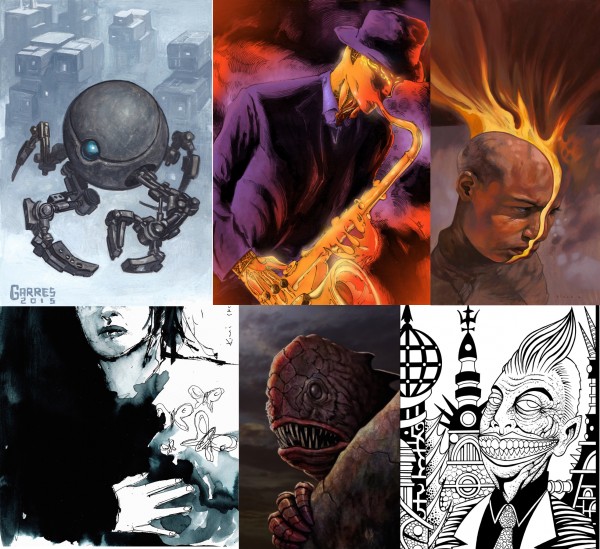
Those artists are: Rafa Garres, Hüseyin Özkan, Sinclair Klugarsh, Steven Russell Black, Eric York, Stéphane De Caneva, Dug Nation, and Frank Walls.  Please click on their names to see their art. Also see below for some artwork from Visions from Punktown.

The artists, along with Taylor, are working closely with Jeffrey Thomas in order to faithfully adapt his work. In eschewing producing the project with major publishers, all the creators have complete control over the work, allowing for more flexibility and freedom.

This is what Kickstarter allows creators to do: work unhindered by the rigid structure of corporate and editorial oversight that can often stifle creativity and  the free flow of ideas and communication.

Visions from Punktown needs your help in bringing this project to life. Please see the Kickstarter, and the Facebook pageJeffrey Thomas’ Amazon Author page here.

For interviews or additional information, please contact Christopher Taylor at: visionsfrompunktown@gmail.com
Twitter: @PunktownerChris
Instagram: @visionsfrompunktown

Thank you for your time!

--Chris Taylor
________________________________________________________________________

Stéphane De Caneva
Free Jeffrey Thomas fiction!

If you aren't familiar with Jeffrey's work, this is your chance to read a story for FREE, as well get a good look at the scripting process.

Link to "Precious Metal" here

You don't need a Dropbox account to view or download this file on a PC or Mac. But you will need the free Dropbox app to see it on a mobile device.

The PDF also includes some previously published work by my collaborator on the adaptation, Stéphane De Caneva! You can see how incredible the finished product will look!

Wednesday, October 15, 2014

Publishing Update: Reviews of THE MISSION

Cover design by Ives Hovanessian

Upon abandoning a long, mediocre stretch as a screenwriter and officially entering the ring of dark fiction in 2010, I've had many stories published in various anthologies, publications and other mediums.  But it wasn't until 2014 that the very first stand-alone book of my work came out with The Mission, which was released as a limited edition chapbook by Dunhams Manor Press/Dynatox Ministries, founded and run by the gifted writer and publisher Jordan Krall, one of the hardest working fellows in indie press.

The book shipped throughout August and September, and the feedback so far has been wonderfully positive.  The Arkham Digest published a review in early October, while Daring Defenders put up a piece on The Mission several weeks back.  Recently, several authors I admire, respect, and count as inspirations in the Speculative Fiction omniverse have chimed in with their thoughts on The Mission, including Laird Barron, Nathan Ballingrud, and Jeffrey Thomas - three greats spinning their craft at the very top of the field.  I'm so very appreciative for all of these reviews and blurbs, and although they cannot lift sales with the book being out-of-print, it is still a lovely thing to know that your work connected with a reader.

As The Mission is not listed on Amazon or Goodreads or any of the usual review sites, I've decided to wrangle reviews into one electronic corral, for personal posterity if nothing else.  This will be - and has been - updated as necessary:
____________________________________________________________________

Award-winning author of the Weird, the Noir, and the cosmically horrific Laird Barron wrote:
"The Mission--an unholy union of Cormac McCarthy's annihilating moral vistas and filmmaker JT Petty's dark vision of the West."
____________________________________________________________________

Shirley Jackson Award-winning dark fiction author Nathan Ballingrud wrote:
"'Goddamn a thief that salutes you first.' 
THE MISSION, by Ted E. Grau, reads like a classic weird tale. It has echoes of Howard, Lovecraft, and even a hint of Clark Ashton Smith's 'Tsathoggua,' but written with greater worldliness and sharper, cleaner prose. A band of unlikely soldiers set off to track down two Lakota warriors in Nebraska, and stumble across something fantastically strange and terrifying. Creepy, bizarre, and fast-paced, this novella satisfied on all fronts.
'Ebke snorted. He had no dog in this fight. Didn't care for a damn thing in the whole wide world, including his own hide. The kind of man who was just born hollow, who just went where he was supposed to. Didn't matter, though. When the chips were down and the dander up, it was always light against dark. To hell with this New World.'
'Farm boys ain't exactly expert trackers. Good to have at your side in a saloon dust up, as those coffee can fists always found purchase, but rosy-cheeked plowboys weren't born bloodhounds like those with a more suspicious nature.' 
Coffee-can fists. I love that. This is the first in what will be a series of stories about Salt Creek, according to the back-cover copy of this sadly out-of-print novella. I'm on board for the full ride."
 ________________________________________________________________________

Acclaimed Horror, Lovecraftian, and Weird Fiction author Jeffrey Thomas wrote:
"Last night I finished THE MISSION. I can’t express how much I enjoyed it – it’s a knockout. Just one of the most engrossing, riveting, creepiest stories I've read in a long time. Truly, this is the most muscular, gritty, thrilling approach to horror I've experienced since I read Laird’s latest collection (and I include the entire contents of CHILDREN OF OLD LEECH in that assessment...). I was out there WITH those guys, in that hard landscape… experiencing one mind-boggling mystery after another. 
Grau packed an incredible amount of strange revelations and dangerous encounters into one novella, without it ever feeling crowded or overdone. He just pulled that Wild Bunch of cowboys in deeper and deeper, took them further and further, and me as a reader along with them. I hope to see a return to this location and these thoroughly intriguing mysteries in future work, as the back cover hints. 
So very impressed. He just consistently impresses…but this one is especially noteworthy. I don’t know if it quite tops THE SCREAMER, which I have a special fondness for and consider a modern masterpiece, but I’d say it’s pretty damn close. 
Again, I’m proud to possess #1 of this chapbook, which somewhere in the near future could become quite the collector’s item!"
____________________________________________________________________

Rodney Turner of Daring Defenders said:
"I recently acquired The Mission, a weird western by T. E. Grau published by Dunhams Manor Press. I’m sad that it was a limited run because this is a fucking excellent little book. If you didn't get your hands on it, light a candle and mourn your loss.
OK, that is quite enough mourning. Let’s get to it! 
The Mission is the tale of a rag-tag group of soldiers on the trail of a pair of Native-American fugitives. A chance encounter in a town that shouldn't exist sets in motion a chain of events that shatters the sanity of our protagonists. 
This not the West of 1950’s cinema with its bright blue skies and crimson mesas. From the first paragraph, Grau drags the reader into an ugly world. A world in which humanity’s self-inflicted horrors walk hand in hand with the ancient secrets lurking in the frontier. 
Grau’s pacing is frenetic, evoking the sense of urgency felt by the narrator and his companions. Like any good story, The Mission made me feel less like a reader and more like a powerless observer carried along inside the narrator’s head. It is not until the characters arrive at the titular mission that we really catch our breath. Grau gives us a brief moment of wonder and discovery, but it is a moment colored by the fact that the light at the end of the tunnel is just the reflection of the Reaper’s scythe. 
I’m going to give this one a 5 of 5."
____________________________________________________________________

Reviewer and editor and all-around voracious Horrorhound Justin Steele of The Arkham Digest wrote:
"I've always been partial to the Weird Western... T.E. Grau’s The Mission serves as prime example of what can be done when these two genres collide. The novella starts off with a typical Western plot; a group of Army men are on the hunt for a couple of Native Americans. Grau shows what can be accomplished when combining the West with the horrors of Lovecraft, as the men make some strange discoveries. 
The tension of the group is already thick when the novel begins, with some members clashing over racial differences and just skimming the boiling point. Once the stage is set, the already palpable tension ratchets into overdrive for the remainder of the novella. As the group is beset by strange occurrences, such as finding an out of place town where a town shouldn't be, the Captain does his best to stay cool and keep his group from tearing each other apart. 
Some of The Mission brought to mind The Men From Porlock or Blackwood’s Baby by Laird Barron. All three stories are period pieces featuring groups of tough guys coming face to face with horrors beyond their comprehension. Grau nails the rough tone required to portray these types of characters, making for a story that has already moved high up on my list of favorite Weird Westerns."
___________________________________________________________________

Bizarro author David Anderson wrote:
"A few months back, in the thick of summer, I was given a copy of T.E. Grau’s THE MISSION and happily accepted it. Limited to 50 hard copies (I got a digital review copy) I was excited to be able to dig into this tasty gem from Dynatox Ministries’ Dunhams Manor Press...
Grau, who’s work I've read before, not only continues to amaze me with this story but sets a new precedent. The ending is terrifying, and stuck with me for long after the story. I can look back on that feeling of hopelessness and cosmic doom and smile because it was invoked so well. Anchored by a really well done Western Story motif, THE MISSION has a cast of characters that immediately launched off the page and held my interest throughout. The pace is amazing, and given the smaller format here we are just HANDED the goods right away and they keep coming. Fans of Lovecraftian fiction will love, love, LOVE this, as it invokes the dread of the Mythos in a very classic way. There have been a lot of experimental Lovecraftian releases like Jordan Krall’s NIGHTMARES OF A LOVECRAFTIAN MIND that explore different ways to tackle the Mythos, but here Grau delivers what fans of classic Lovecraftian Fiction crave most – cosmic monsters! And scary stuff! There’s still enough to tickle your cranium, mysteries to explore, but we still get some hair raising chills. 
THE MISSION is a valuable edition to your collection."
_____________________________________________________________________

Editor David Binks wrote:
"I highly recommend it.  Well written, good pace and it seemed to have a hint of Clive Barker which is always a good thing.  Everville comes to mind.  The characters were believable and flawed like most of us.  Grau takes the reader into the flat lands of Western Nebraska, a part of the world he knows and describes very well,  building up the suspense as he adds more ingredients to the mix. And if that weren't enough, we realize that we are reading a Lovecraftian work. My only hope is that this becomes a full length novel one day."
_____________________________________________________________________

While The Mission is no longer available as a chapbook, it will be included in my debut collection of short fiction, which should be completed quite soon.  More updates as they are made available.

Wednesday, May 21, 2014

TC Review & Interview: Acclaimed horror author and Punktown creator Jeffrey Thomas scores big with collection WORSHIP THE NIGHT, now available from Dark Renaissance Books

Cover by Erin Wells

It only took me one page to fall for Jeffrey Thomas.

It was several years back, and I had just received Unholy Dimensions - which is one of the best "concept collections" that I've ever read, Lovecraftian or otherwise - via the post as a gift from the author, and after choosing to remain undeterred by the rather uninspiring cover (as an admitted art/design snob, I always judge books, in whatever small way, by their covers), I dove in excitedly, based entirely on Thomas' reputation amongst fellow writers of the dark and Mythosy.  The opening story in the collection was titled "Bones of the Old Ones," and by the time I'd finished that first page, I knew that I very much liked the way this Thomas fella put together a sentence, how he etched out a scene and drew up his characters.  How he melded crime fiction with science fiction in one story, and how he paid homage to classic Weird lit in another.  How he built his worlds and all the new and dark things that exist there.  Punktown.  Lords of the seven moons, how I swooned hard for Punktown.

Much like a woman knowing within the first five seconds of a blind date if they're ever going to disrobe with that person wiping their brow across from them, a reader often knows after that first page if they're on board with an author, or looking for the exit.  For me, with Unholy Dimensions, it was love at first sight, and that affection has only grown with each new Jeffrey Thomas story, novella, and novel I've read since then, and there have been many.

In addition to being a precise stylist who weaves in enough poetry without turning purple, Thomas is one of those Big Creators, who has carved out vast swathes of newly tamed real estate from the jungle of the abyss, with the most famous of these being the above-mentioned Punktown, the fictional frontier planet that serves as a crossroads for a menagerie of races and entities all struggling to thrive and survive in a bleak, proto-Lovecraftian universe.  And while Punktown put him on the map, and is his most recognizable brand, he's written so much more than that, including a series of stories and novels set in his version of an urbanized Hades, and dozens of other stories and books situated in more general Speculative Fiction arenas, that have been translated into numerous languages around the globe.

Thomas is an important writer of Horror Fiction, and based on his output, range, and immense talent, he deserves to be a household name in the genre, mentioned in concert with the elite writers of dark literature over the past two decades.  Maybe he already is (I don't get out to conventions much), and if so, there is some justice in the cold creative world.  I just know that writers like Thomas should be writing for a living.  Full time.  Cashing checks from Big Apple book deals that allow him a comfortable existence without the need for a distracting "day job," where each hour spent away from the keyboard is another hour ripped from the dark canon.  Thomas was put here to write books of scary stories and Cosmic Horror.  Black, unsettling stuff, and lots of it.  He can surely shoulder the burden, based on his bibliography, as well as his recent and upcoming slate of projects.  Hopefully, someday very soon, The Bigs will come calling, and Jeffrey Thomas' emergence in the shopping mall book store (do they even have those anymore) will finally come to pass.  It has to work out that way.  How can it not?  I mean, Front Shelf writers belong on that Front Shelf, in the mall or otherwise.

With that preachy preamble behind us, I can put away the soap box and move on to the topic at hand, which is Jeffrey Thomas' recent collection Worship The Night (Dark Renaissance Books, 2013).  I say "recent" and not "latest," as I requested a review of the book not too long ago, when it was Thomas' newest release, coming out on the heels of Encounters With Enoch Coffin (written in collaboration with famed Lovecraftian scribe W.H. Pugmire).  Today, as of press time, it is now his second most recent collection, as Ghosts of Punktown was released just last week.  So, you see what I mean about the whole "prolific" thing.

In Worship The Night, Thomas gives us eight substantial tales that run the dark gamut while showing his range, in terms of tone, location, and POV.  Starting with the cover image, many of the stories here seem intensely personal, revealing a candor that is refreshing in Horror Fiction, which can sometimes drape itself in a detached, Kubrickian facade while bloodlessly describing scenes of profound violence.  For what I count as the strongest stories in this collection, Thomas digs deep into his own meat and bones to reveal fresh terrors told in that clean, elegant way that marks all of Jeffrey Thomas' work

"The Lost Family" opens the assembly, and features the seraphic protagonist from his novel Fall of Hades, picking up her trail somewhere midway through that book, giving it a feel of a unearthed chapter.  Thomas' construction of the landscape (cityscape?) of Hell is incredibly interesting, and made somehow simultaneously more hopeful as well as hopeless than your usual portrayals of the Underworld.   An eternal realm of endless terrain is compressed into a claustrophobic crawl through the machinery of damnation, in a realm that is more dangerous than I thought possible.

"Counterclockwise" is the collection's sole Punktown story, and it's a dandy, centering on the bizarre mechanics of one of the many alien cults that have taken up residence on this rough and tumble planet, in this case the mysterious Groi (hmm).  A massive clock tower - "a nightmarish wedding cake of black metal, tiered layers that tapered to the huge clock face that surmounted it" - built across the street from an apartment building drives a tenant to distraction, and then to a whole lot more.  Uninitiated readers also get an introduction to the Choom, the wide-mouthed species indigenous to Oasis (nicknamed "Punktown" - a local epithet that stuck) who collaborate with the human settlers now running the megalopolis, from shipping to shopping to the police force.  Thomas' deft handling of alien races, and the unwholesome monuments they erect, is on full display in that yellowish green clock face of "Counterclockwise."  gur... gur... gur..

"The Holy Bowl" flies in the face of its often comical ruling deity, and possesses a tone that reminds me of the works of Mark Samuels or Thomas Ligotti.  Grim, mean, and hopelessly cold.  I've never read a Jeffrey Thomas story like this, and was pleasantly surprised by the vague familiarity of the setting, and the brutality that waits therein.

"In Limbo," written specifically for this collection, is the first of the outwardly personal stories in Worship The Night, which lends the work a resonant weight that is as heart rending as it is chilling.  Written during the confluence of Hurricane Sandy, Halloween, and what Thomas terms "Life itself" in 2012, "In Limbo" sets a story to which we can all relate in a setting we all recognize, and then drops that cozy, tattered quilt over the cliff into a ravine of nightmares, where the End of Everything might be just outside your door, and seeping into your home.

In "About the Author" and "The Strange Case of Crazy Joe Gallo," you can see Thomas having fun, spoofing trope-chasing while celebrating truth being stranger than fiction in the former, and playing fast and Lovecraftian loose with gangland history in the latter.  Oddly enough, I picked up The Mad Ones: Crazy Joe Gallo and the Revolution at the End of the Underworld from the library the same week as I received Worship The Night.  I haven't yet read the Gallo book, but I'm certain - much to my chagrin - that I won't find any Mythos undertones, nor homages to S. T. Joshi in the official biography of this charismatic Mafioso.

With these light interludes concluded, the plate is cleared for the two remaining stories, both of which are sizable slabs of spitting darkness that seem to build off of each other. "Children of the Dragon" takes our male American protagonist (probably not-so-coincidentally named "French") to Vietnam, a country with which Thomas is intimately acquainted.  In looking for strange, possibly mythical creatures in the haunted jungles and lakes of Southeast Asia, our cryptozoologist first falls for a local bar girl, who becomes his key to discovering hidden-in-plain-sight secrets he never dared imagine.  "Children of the Dragon" is essentially a Lovecraftian piece, set in real world locations visited by Thomas himself, doused in a patina of cosmic dread.  This, of course, grounds a darkly fantastical tale in the minutia of reality, giving it a vibe of being not only wholly possible, but most likely true.

In "The Sea of Flesh," we see the United States - specifically, Salem, Massachusetts - through the eyes of an American-born child of Vietnamese immigrants, and her struggles with identity in two worlds that don't fully embrace her.  This is a 40 page novelette, which could have been expanded out into a full-on novel with just a tad bit of padding, but thankful stays mean and lean and included as the final story in Worship The Night.  "The Sea of Flesh" is a big, layered story populated by complex, multidimensional characters that struggle with job and family, secret desires and the dangers of shared dreaming.  Especially in Salem, around Halloween, days after a rotting hulk of fleshy matter washes up into the harbor.  It's an award-worthy work of Horror Fiction, and I found myself hoping that the story would never end, partly out of a desire to stay in that bluish world of sporadic joy and crushing sadness, but also because I could see the clouds of doom building on the horizon, and wanted to keep them at bay before they could overtake the land and flatten the souls living there.  Some people deserve happiness, and never get it.  Some find it, and then have it taken from them.  Both are cruel, but the latter is the cruelest.
_________________________________________________________________________


TC:  First of all, thank you for taking the time to sit down with The Cosmicomicon and share with all of us.  It’s a true honor to have someone of your stature and talent gracing the electronic pages of TC.

JT:  You’re too kind, Ted. I appreciate you giving me the opportunity to speak about my work – you’ve been very supportive of it.

If you could, and for anyone living under a very heavy and stubborn rock the past few decades, give us a little background on your writing career.  When did you sell your first story, and how did that feel?  Has the “thrill of the sale” gone away over the years?  

Without digging through my records, I’m going to say it was a story called “The White Bat,” accepted by a small press zine called Dead of Night, in 1990. I was over the moon, because I was thirty-three at that time, and had wanted to be a published writer since I was a young boy. In a very humble way, that dream had been realized. That was the start of a long string of sales to small press zines, though that same year I also sold a story to Fangoria’s sister magazine, Gorezone. Ten years later, after having placed stories in a number of anthologies along the way, my first two books came out in rapid succession: the collections Terror Incognita (Delirium Books) and Punktown (Ministry of Whimsy Press). It’s been book after book since then, with most years seeing several published. I feel it was the critical success of Punktown that got that snowball rolling, so I have Jeff VandeerMeer to thank for publishing that book. As for the continued thrill of the sale…well, there are times when I feel a little jaded, which I think is natural, as is the fact that I’m more excited by some sales than others. Naturally, a “best of” or higher profile anthology sale is going to be greater cause for celebration. Sometimes I have to turn down requests to contribute to certain anthologies or publications, because of time constraints (I have a day job, don’t ya know). If I catch myself thinking, “Oh man, I just don’t have the time for that,” as if impatient or overwhelmed, then I need to mentally slap myself and remember the days when being published in anything was still just a dream. For an analogy, I’m reminded of when I was married to my first wife and one night she was feeling romantic, but I was playing "The Legend of Zelda," and I was like, “Come on, I’m in Level 8!” I had to stop and go, oh my God, what happened to me? You know, when you’re younger and going to bed with someone is all you aspire to. So, we need to reevaluate our perspective sometimes! Still, the years have also brought more realistic expectations about being published, and whatever it is that constitutes “fame.” I know I’ll never be famous, so that subdues the fires to a steady low burn, but knowing I have readers who come back to my work keeps those fires from going out altogether.

I think influences are fascinating, and am convinced that childhood interests follow a person for the rest of their lives. With that so clumsily proclaimed, what authors (or genres) did you read during your childhood?  What was your first brush with dark fiction and the fantastical?

I agree about those childhood influences. When I was a kid, "Planet of the Apes" was my favorite movie, and I think it sticks with me to this day…mainly, using science fiction or the fantastic as a vehicle for satire or social commentary, as I do in my far-future Punktown stories. When I was about ten, my favorite novel was Oliver Twist, and likewise I think that book inspired something that recurs in my work: the notion of a person trying to hold onto some kind of goodness at their core, to maintain their dignity, in an environment of oppressive darkness, as Oliver did as an impoverished orphan and later in the company of criminals. That theme of endeavoring to walk upright in a crushing universe is not only important to my Punktown stories, but my series of stories set in Hades, as well. As for my other childhood fiction reading, it was much more geared toward science fiction than horror, until I got into my teens and read novels like I am Legend and The Exorcist, though of course I’d always loved horror movies.

Even from a young age, did you always see yourself as someday becoming a writer?  Was this vocation preordained, or did it become unavoidable later in life?

I've wanted to be a writer since I could write at all, though it mostly started out with my own little comic books. At ten I was trying to write novels, at fourteen completed my first novel, and at fifteen submitted my first novel to a publisher. (It was rejected; as I say, it wasn’t until I was forty-three that I sold my first book.) That novel was a weird combination of "Planet of the Apes" and "A Clockwork Orange." It takes place on a planet colonized by humans, where the indigenous beings are simians. Strife exists between the humans and simians, and youth gangs comprised of either or both races are getting into all kinds of mischief. I think anyone familiar with my Punktown stories can see something larval there. But yes, maybe it was preordained that I become a writer, because the gene is strong in my family. My father was a locally published poet, my mother wrote poetry and a newspaper column, as a teen my sister wrote a newspaper column, and of course my younger brother Scott Thomas is a respected author of horror and fantasy. It was my destiny!

Unlike some contemporary writers of cosmic horror and fiction termed “Lovecraftian,” you use actual names, locations, and other bits of HPL’s work in your own, instead of dancing around it.  Was it a conscious choice to write straight-ahead Lovecraftian fiction, or did the ideas just come out that way on the page?

When I first started writing Lovecraft-inspired work, my inclination was usually to link it directly to his universe, and most of those earlier works were collected in my 2005 book Unholy Dimensions. These days I’m less inclined to name names, preferring a Lovecraftian vibe or approach in the broader sense of that term. Though it depends on the project. For the collection Encounters With Enoch Coffin, which I coauthored with W. H. Pugmire, we both made direct use of Lovecraft’s world and creations.

It might sound crass, or possibly inappropriate, but I feel compelled to mention this:  For as many years as you have been writing, the output you have shown, the creation of a brand new world of limitless possibility (Punktown), and with the quality of your work and the accolades it has received, I just can’t figure out why “Jeffrey Thomas” isn’t a household name in the more gentrified parts of Horror/Weird Fiction Town.  All that said, are you ever confused as to why it is harder for some writers to break through to that next level (a relative term) than others?  I know it’s not about skill, as Big Publishers have come calling for lesser talents.  Is it timing?  Genre?  Expertise in dark arts of convention politicking?

These things aren’t always about level of skill, you’re right. It may sound cynical or like sour grapes, but I’m certain schmoozing and politics can play a part in one’s level of success. You see it, it’s plain. Also, bombastic self-promotion has taken some writers farther than their skill level might merit. And yup, luck and timing. And then I have to squarely blame myself for not trying harder to crack the larger publishers, after suffering disappointments in the early days of my career. But I think you really hit on something when you said genre, and here is where I might really prove to be my own worst enemy. A large percentage of my output has been set in Punktown, and those stories blend the genres of science fiction and horror, not to mention crime fiction and, well, everything else but the kitchen sink. I think most of us who love science fiction movies also love horror movies, and you see horror and SF mixed freely in movies all the time (come on: "Alien"). But when it comes to reading, I don’t know, I think for most people it’s still either/or. SF purists might not care for the strong horror elements of much (though not all) of my Punktown work, while many horror readers may not feel comfortable with a futuristic, extraterrestrial setting. To me, it’s chocolate meets peanut butter, so I don’t get it. But let’s get back to the part about me not being proactive enough; that’s been a big problem for me. I’ve had three mass market novels, and for all three of them, the publisher approached me, asked me to write them something for them. Had they not done that, to this day I might not have had any books that were released by a larger publisher. I don’t know, maybe I just don’t like those long waits for the big houses to reply one way or the other. Maybe I became too comfortable on the level where I stand, and move laterally rather than reach higher. But I’m still pleased with my career, still very grateful. Again, you have to stop and remember being that guy who completed stories only to file them away in the closet, unread and unknown. I count my blessings that I have a bunch of gorgeous indie press books with my name on the cover…and yeah, those three mass market books (A Nightmare on Elm Street: The Dream Dealers, Deadstock, and Blue War) will always be feathers in my cap.

Now that I got you in trouble, let’s change gears at bit, and get to Worship The Night.  This seems like one of your most personal collections, with stories like “In Limbo,” “Children of the Dragon,” and “The Sea of Flesh” seeming to hew very close to the reality bone.  Was this intentional, to dig so close to home?  Or was it just a matter of timing, with the stories reflecting what was going on around you at the time?

I didn’t set out to make Worship the Night a more personal kind of collection than others; it just developed that way via the law of averages, since a lot of my stories – sometimes even the most fantastical stuff, like some of the pieces in my latest, Ghosts of Punktown – draw on my personal experiences, or at least my emotional/psychological state. But however it came together, yes, Worship the Night did turn out that way as a whole. It’s a cathartic process, writing that type of story; but more importantly, it can make the work connect with the reader on a deeper level. Maybe the reader has been through the same kind of experience, or something analogous, and certainly the reader has felt those profound emotions before, experienced those fears or desires. That stuff tastes different on the page when it comes from some level of reality. You aren’t faking it. (You know how a CGI person, no matter how highly detailed, just never looks truly alive?) It’s potent raw material, but it can be tricky to make it work in a fictional presentation, where entertainment always has to be your foremost concern.

Based on its characters, plotting, themes, and execution, I find the novella “The Sea of Flesh” to be an achievement in contemporary horror fiction, and see it as a story that could have easily stretched into a novel.  Did you have any size constraints on it when you began writing it?

Only roughly was there a constraint to keep it on the shorter size as a novel. The story came about when Sea Wallace of Prime Books asked me and my brother Scott to each write a short novel inspired by a piece of artwork created by Travis Anthony Soumis, which became the cover for the finished book, The Sea of Flesh and Ash. But publication was delayed for some years, so eventually we moved the book to an emerging publisher, Terradan Press. The book hasn’t received much exposure, though, hence my decision to reprint “The Sea of Flesh” in Worship the Night. (And Scott’s short novel, The Sea of Ash, is thankfully going to be released as an ebook by Mike Davis of The Lovecraft eZine, who loved Scott’s story to death.) I’m satisfied with the length of the story, though I suppose I could have opened it up further. I think most any short story could be made larger, and a lot of novels could be much more condensed. Some novels feel bloated to me and overstay their welcome, so my own don’t typically get too bulky. My feeling is that the horror story is usually best served by the short form. In the end, unless I’m writing for an anthology with a set word limit, I like to let a story be the length it wants to be, organically.

As you have included “Counterclockwise” in Worship The Night, I want to talk Punktown a little bit, as I find it to be a very rich, varied, and often terrifying world that is an important landmark in the map of cosmic horror fiction.  How and why did you create Punktown, and what did you originally want to do with this place?  Has it lived up to its promise, and has it surprised you while constructing it, block by block, story by story?  How many more Punktown stories do you think are out there?

I came up with the whole fundamental concept of Punktown while riding with my dad somewhere, maybe home from my job, back in 1980. It just sort of burst up from wherever it was brewing in my subconscious, or my muse lagoon, or what have you. I wanted to write of this weird city – more phantasmagorical than strictly science fictional – where any kind of surreal craziness could go down, sort of like a literary Bosch painting. I think the setting has exceeded my initial expectations; it’s grown outwards and upwards over the years, like the city itself. Because all Punktown stories function independently of each other, and rarely carry over the same characters, there’s so much yet to be experienced there that I could no more tire of writing about it than another writer might tire of writing about this world.

“Children of the Dragon” first appeared in the book Geschichten aus dem Cthulhu-Mythos from Festa Verlag as a German translation.  You seem to have a healthy following in Germany (as well as Russia, Poland, and Greece) for your books, both in print and audio.  How did Punktown spread to the Old Country?

The same way I sold those three mass market books: they approached me! Thank God my publishers are more aggressive than I am. Germany’s Festa Verlag was the first publisher to do a translated edition of one of my books: a German language hardcover of Punktown, which featured artwork by H. R. Giger on the cover. Giger signed all the signature sheets, as well. Other translations came later, including a Taiwanese edition of my novel Letters From Hades. I continue to work with Festa, a great publisher, and these days my sales in Germany are stronger than my English language sales. And yes, there was even a three volume set of Punktown stories done as wonderful audio readings, by professional actors, from the company Lausch.

Is the project to turn Punktown into an RPG still in the works?

It is, though it’s unfortunately been moving more slowly than everyone had hoped. It was funded by the publisher’s Kickstarter program, which went over $4,500 beyond its $9,000 goal, but I think the delay has mainly come from transitioning the game from Miskatonic River Press to Chronicle City, who came into the picture late in the game (pardon the pun). All the text is finished, but there’s the matter of getting the interior artwork and maps created.

Tell us a little about your newest book, Ghosts of Punktown.  How has it been working with Dark Regions Press?

I actually turned Ghosts of Punktown in to Dark Regions a few years ago, but I think the delay there was again one of transition: from previous owner Joe Morey to his son Chris Morey. (I’m fond of both guys, Joe being the publisher of Worship the Night via his new imprint, Dark Renaissance Books.) Chris has been awesome to work with; he really wants to make this book something special. Ghosts of Punktown is my darkest Punktown collection, and I guess that’s saying something. It apparently left its Publishers Weekly reviewer in need of smelling salts. The violence in some of the stories all but blinded the reviewer to any other of the book’s qualities or merits. It was a case of a book ending up in the wrong reviewer’s hands. Conversely, Rue Morgue was highly favorable and didn’t mention the violence at all. That being said, it is an intense bunch of stories, and it isn’t inappropriate to feel disturbed by them.


As a huge Kris Kuksi fan, how did you score one of his works to use as the cover of Ghosts of Punktown?

I can’t recall where I found the first examples of his remarkable artwork, but when I did I went straight to check out his web site. I was so blown away that I entered something like a desperate panic – I needed this guy’s work to be on the cover of Ghosts of Punktown! I approached Joe Morey and asked him if we could request using one of Kuksi’s preexisting sculptures as our cover image. Joe said go for it, and so I approached Kuksi himself and found him to be very cool to work with. Later on, Chris Morey went back to Kuksi and asked if we could use a second image on the back cover of the deluxe lettered edition of the book. Kuksi consented, and not only that, agreed to sign all the lettered edition’s signature sheets, as well. I’m blessed to have had some of my favorite artists represented on the covers of my books: not only Giger and Kuksi, but people like Stephan Martiniere and Alan M. Clark.

I usually ask this of writers, especially ones who have been writing for more than just a few years, and who have made an impact on speculative fiction:  How has the nature, makeup, and tone of the weird/horror fiction scene changed during your tenure in the trenches?

I’ve seen a major change, from work that was influenced mainly by bestsellers like Stephen King to work inspired by more weirdly imaginative and daring authors (ironically, from further back in the literary annals) like Lovecraft, Chambers, Blackwood, and so on. I think all the talk and controversy surrounding New Weird and what it is, and if it is, was beneficial in that it stimulated more thought about weird fiction in general. And the massive anthology The Weird, edited by Ann VanderMeer and Jeff VanderMeer, not only furthered that conversation but helped expose current writers to a richer legacy of fantastical fiction than they were perhaps exposed to before. We’re in a new golden age of the weird tale (oops, I used “new” and “weird” in the same sentence; sue me), with people like Livia Llewellyn, Michael Cisco, and so many others delivering artistic, exhilarating, unpredictable work. Within just a couple of months I read new collections by Laird Barron, John Langan, and Nathan Ballingrud that just blew my mind. Unfortunately, the work of these brilliant authors will never reach the level of sales of King’s work, but the horror connoisseur who seeks them out will be richly rewarded.

What do you hope to see out of weird fiction going forward?  

More of what I’m seeing now…more and more of it!

Do you have any advice for aspiring writers of horror fiction, or fiction in general?

Read me to learn how it’s done. Sorry, I’m trying to be more concise as the interview draws to its close. And I need to sell books, bottom line.

Any last words, before I replace the blindfold and light up the cigarette?

Cigarette? What are you trying to do, kill me?

Thank you very much, Jeffrey, for sharing your time, energy, insights and stories with us.  We wish you only the very best, both on and off the page, and look forward to reading your work for a long, long time.


Thursday, February 20, 2014

Editing News: Strange Aeons Lost Issue #13 Found, and Now Available to Backers of the 2014 H.P. Lovecraft Film Festival - Portland

Cover art by Mike Dubisch

Time certainly does fly, doesn't it?  It must, as I have now served as Fiction Editor of Strange Aeons magazine for a little over two years, and have enjoyed every goddamn second of it.  Truly, it has been an incredibly fun and rewarding experience sourcing stories and working with amazing writers, and then feeling the pride of releasing those words and images and nightmares out into the ether.  The only down side has been the loathsome task of sending out rejections for great stories, as featuring only one piece of fiction per issue means the culling staff is firm and unforgiving.

While the one story per issue will continue, I'm proud to announce that we've just sewn up our very first ALL FICTION issue of Strange Aeons, which will be released as our "lost" Issue #13, featuring 13 writers in 76 pages, and is only available to those who pledge $10 and above to the 2014 H.P. Lovecraft Film Festival - Portland through their Kickstarter campaign.  BUT YOU ONLY HAVE FOUR (4) DAYS LEFT, as this whole shebang closes down Monday, February 24th at 11:59 pm PST.  So get on your Huffy and haul ass before your access to this amazing special edition will be closed.

Strange Aeons Lost Issue #13 will be our largest issue yet, by far, and is made up of a mix of new, unpublished stories, re-printed tales new to the pages of the mag, and stories published under my tenure up to the present day.  Basically, if you missed any of the past issues going back to Spring 2012, worry not, silly scoundrel, you can get them all here, along with some fantastic fresh meat never before read by human eyes.

So, at long last, here is the ToC for Strange Aeons #13, listed in order of appearance:

"Welcome to the Reptile House" by Stephen Graham Jones
"The Impossibility Dissection" by Stuart Young
"Sunset on Megalopolis" by Jeffrey Thomas
"De Profundis" by Daniel Mills
"There's No Light Between Floors" by Paul Tremblay
"Insides Out" by Gary McMahon
"Folie a Deux" by Ross E. Lockhart
"The Astral Mask" by Richard Gavin
"You Are What You Eat" by Scott Nicolay
"Beautiful" by John Claude Smith
"Remains" by Orrin Grey
"Dog Will Hunt" by Ives Hovanessian
"Go, Go, Go, Said the Byakhee" by Molly Tanzer

This is a choice line-up, folks.  An A-Team, of sorts, sans mohawk and overzealous layering of gold chains (although Jeffrey has been known to go about 9-10 deep with the platinum and ice).  I'd put this group up against anyone in any antho or fiction journal coming out this year, and bet the house on the W.

So don't tarry, terry, or even teri.  Go support the good folks who are putting together the HPL FF PDX, and in the process, you'll get a collection of Weird/Cosmic/Horror/Dark Fiction that will amaze and delight your friends and colleagues, while gravely disappointing our parents.  Isn't that what life is all about?


And now the (semi)official stuff, from our website, and a snazzy vid below:

ISSUE # 13

Through incredible luck (and just a bit of eldritch wizardry) we've manged to secure a way for you to acquire what is now known as the 'lost' Issue 13!

As some of you may know, as 2013 drew to a close we began working on Issue 13. Through an unfortunate and unforeseen accident here at the SA offices, all of our files relating to the issue fell through a dimensional vortex and were feared lost.

Like any respectable Innsmouth hotel, we decided to skip Issue 13, and let it lie dreaming wherever it ended up. After collecting ourselves and counting our lucky elder signs that only the poor mailroom boy was lost along with the issue, we continued on and began working on Issue 14.

Miraculously earlier this month, a colleague of ours managed to track down the missing issue through means we are not at liberty to discuss. Suffice it to say that we owe you one...thanks, Erich!

The gracious folks at the H.P. Lovecraft Film Festival & CthulhuCon have offered to help us reconstitute the recovered pages, so for a very limited time, all backers of their HPLFF 2014 Kickstarter campaign can upgrade their pledge and our ALL-FICTION Issue 13 can be yours UNTIL THE END OF THIS MONTH.

This will be a special fiction issue including the talents of Ross E. Lockhart, Jeffrey Thomas, Scott Nicolay, Gary McMahon, Stephen Graham Jones, Stuart Young, and many others. It also features a wonderful cover by Mike Dubisch and interior illustrations by Allen K., Lee Davis, and Nick Gucker!

The best part is how easy it is to add Issue 13 to your collection. For as little as $1, you can become a backer of the HPLFF Kickstarter, and then simply add on the $10 upgrade amount to reserve your copy. This issue will only be available during the Kickstarter campaign, so make sure you grab your copy while you can! Please watch the video below to learn more about the HPLFF and pledge your support for the best Lovecraftian festival on earth!


Tuesday, January 14, 2014

TC Editor Interview: Brian M. Sammons and Glynn Owen Barrass Discuss Release of Lovecraftian Cyberpunk Anthology 'Eldritch Chrome,' Now Available from Chaosium, Inc.

Cover art by Daniele Serra

I'd like to share a recent interview I conducted with authors/editors Brian M. Sammons and Glynn Owen Barrass, on the occasion of the release of Eldritch Chrome, an anthology bristling with 18 tales of Lovecraftian Cyberpunk penned by some of the finest names working in Speculative Fiction today.

If you like your punk cybernetic, your future dystopian, and you tentacles biomechanical, this is the book for you.  Pull up tight your vinyl sheets, strap on your kinked out breathing apparatus, and settle in for an unsettling read.

Please enjoy my chat with Brian and Glynn, and thanks to the lads for sitting down with The Cosmicomicon.
___________________________________________________________________________

First of all, let’s set the table and give a little background on each of you.  


Glynn: I took up writing rather late I suppose, in my late 30s, but have always been a fan of the written word. Since I first read Lovecraft, at the age of 13, I always wanted to be a writer, and when I graduated university, again late in life, I took pen to paper and began in earnest. Lovecraft, Ramsay Campbell, Raymond Chandler and the Cyberpunk genre are heavy influences in my work. I’ve written over a 100 short stories, most of which have been published in America, England, and Japan.

Brian: I've always been a story teller and that’s why I started running role playing games as a youngster. It allowed me to make up and tell tales to my friends. So as a RPG nerd and a lover of all things horror, I started writing for the Call of Cthulhu RPG in the late 1990s. I then took a long hiatus (not by choice) and when I returned to my keyboard, I started focusing on fiction. While my mainstay has always been horror, I have dabbled in many subgenres such as Lovecraftian, weird, splatter, and I have dabbled in sci-fi, action, and fantasy. I still do game work today and I am currently working with a film company on the screenplay for one of my stories they have optioned to turn into a movie and that’s a real kick.

You both write as well as edit.  Do you value/enjoy one over the other?  

Glynn: Both have their thrills, and I enjoy editing greatly as it gives me a chance to read awesome fiction! Creating fiction is excellent too, the process that goes into bringing a story to life, so this is a tough question. Right now – I enjoy creating a little bit more than editing, but that may change depending on what I’m working on.

Brian: I also prefer to write, because I have that insatiable need to create and tell stories. That said, I do really enjoy editing anthologies and I seem to keep adding more editing projects to the ‘to do’ pile every day. I think I like doing them so much because then I can make the books that I would want to read that no one else seems to be doing. It is a lot of work, and it’s never fun when you have limited space in a book and twice that in great stories to choose from. Rejecting good authors is easily the thing I hate most about being an editor. But to build a book from the ground up, from the initial concept, to selecting all of its contents, to doing all the finishing touches, well that’s what makes all the hard work worth it.

How did you two come together to work on Eldritch Chrome, and from whence did the project arise?  Did the anthology originate from inside Chaosium, or did you take it to the publisher and sell them on it?

Glynn: At the time I was writing a lot of crossed genre Cthulhu Mythos/Cyberpunk stories, and I was chatting to Brian about it one day and just asked him: ‘Wouldn’t it be great to do a book as a collection?’ Brian loved the idea, we put the pitch together, and he was straight on to Chaosium with it, on the condition: ‘Sure man, but I have this great Cthulhu/Steampunk idea that we have to do next.’ Chaosium snapped both ideas up, and a few more besides.

Brian: Glynn and I met on the internet and soon discovered that we had a lot in common. One day while kicking around thoughts about books and stories, he came up with the idea for a Lovecraftian horror meets cyberpunk anthology. I had a long relationship with Chaosium thanks to my Call of Cthulhu writing, and I knew they were looking to jumpstart their slumbering fiction line. They were very interested in the book and so we were off and running.


The cover features artwork by Daniele Serra, a favorite of mine and a name well-known in Weird Fiction circles.  How did you hook up with Dani as the cover artist?

Glynn: We have admired Dani’s work for a while, and when it came to choosing an artist he was our first choice. It was as simple as sending him an email, as Dani loves painting as much as people love admiring his work.

Brian: This was the first time we worked with Dani, but it would not be the last. He also did the cover for this book’s unofficial companion anthology, Steampunk Cthulhu (another collaboration between Glynn and I), and I tapped him again for an amazing cover for an upcoming horror western book called Edge of Sundown. Dani is amazingly talented and just a great guy to work with, so I am sure we will be working with him again and again.

How many submissions did you receive?  Was the volume and quality of the subs about the same as past projects?  What was the most surprising part of the process (if anything)?

Glynn: This was a closed project, so we received about 25 stories. Also this was our first editorial project together but being familiar with the authors already, we knew we would receive quality work.

Brian: Yes, for our first effort together, we decided to go with the authors we were familiar with. Those that we were already fans of. The book that followed it, Steampunk Cthulhu, would be an open call and for that one we read over one million words in submissions! But that’s another story. As for the quality of submissions on Eldritch Chrome, they were all excellent, and perhaps the most surprising part of the process was the number of great stories we got for the book. Of course that meant that many good stories had to be rejected just for lack of space. The one upside to that is that the only best of the best will be found between the covers of Eldritch Chrome, and that makes me very happy.

What can readers expect to find in Eldritch Chrome?  To whom would this anthology appeal?

Glynn: Readers can expect to find unique takes on Cyberpunk and the Cthulhu Mythos genres – the writers here really have excelled in their craft. Really, this anthology will appeal to a lot, we’re not just saying that! Fans of Cyberpunk and Cthulhu, of course, Horror fans, and fans of the individual authors are in for a treat.

Brian: The criteria for making it into this book were twofold. The stories had to be great Lovecraftian/Cthulhu Mythos tales, and they had to be excellent examples of the cyberpunk genre. The authors had to have a strong grasp on both types of tales and those that got the thumbs up from us had that in spades. So if you enjoy reading about the creepy, cosmic horrors that H.P. Lovecraft gave to the world, this book will be for you. If you’re a fan of the dark, dystopian future of cyberpunk, then you’ll also dig Eldritch Chrome. If you are a fan of both, as Glynn and I are, then you’ll love the book.

As editors with a (rapidly growing) track record, what advice can you give to writers seeking to place their work in anthologies such as yours?

Glynn: Heh, well... First of all, read the guidelines well as we are very particular about what we’re looking for. Whatever you do, don’t take an old story and just tack on something to make it match the theme we’re looking for – that stands out terribly and we reject stories like that. Also, proof and edit the hell out of your work before sending it to us. Stories with typos every paragraph rapidly get rejected, but thankfully, the authors we go to are so good at their craft we get stories near hand perfect, which makes an editor’s job far easier.

Brian: Read everything Glynn just said again. And then once more. Got that? Good. The only other thing I could think of to add would be for you to know the genre(s) and the type of stories we’re looking for intimately. If we would do an anthology of Robert E. Howard-like, two-fisted adventure tales set in the world of Alice in Wonderland, then you had better know both R.E.H. stories and the fantastic world that Lewis Carroll crated like the back of your hand. Not having a good understanding of the genre(s) we’re looking for is the surest way to get rejected.

What sort of books would you like to see more of in genre fiction, as writers, editors, and readers?

Glynn: That’s a difficult one. Hmm, more books by us for a start (Laugh, Out, Loud). But seriously, there are some great authors out there that deserve a lot more recognition than they have so far, people that work hard, produce consistently quality work, that we hope we are helping to introduce to a wider audience.

Brian: Glynn beat me to the punch, as he often does, with the answer to what books we would like to see published as writers and editors: books by us, of course. As for what books I’d like to see as a reader, well I have a few more ideas for anthologies that I would love to read. That’s how I usually come up with ideas for the books I edit, so I think I’ll keep those idea to myself for right now. In addition to that, anything by my favorite authors or perhaps more of a return to form from some of my old favorites. Stephen King jumps readily to mind in that regard, although I must confess, I still have yet to read his Doctor Sleep.

What’s next for both of you lads, both individually and as an editing team?

David Lee Ingersoll
Glynn: As a team, there are three more anthologies coming out in the near future: Steampunk Cthulhu and Atomic Age Cthulhu (both from Chaosium) and another project that is sort of a secret that you, Ted, are appearing in with a truly brilliant piece of work. Brian has also written some Call of Cthulhu RPG campaigns that I am proud to have contributed to. Solo-wise, I have a novel being released early 2015, based on the King in Yellow Mythos, and also various Call of Cthulhu and anthology appearances. Brian and I are also soon to be pitching a new Cthulhu Mythos anthology to publishers.

Brian: Since Glynn nailed our team-up projects, I’ll just list some of my other efforts. I am currently working on a novel with an author I admire the hell out of, Jeffrey Thomas. I am editing another Lovecraftian anthology called The Dark Rites of Cthulhu for the brand new publishing house, April Moon Books. I will be co-editing another anthology called The Legacy of the Re-Animator (three guesses as to what that’s about) with the very talented writer, Pete Rawlik. I will be overseeing and editing a collection/shared world anthology for my good friend, C.J. Henderson. I have two ‘straight horror’ (read as: non Cthulhu Mythos) anthologies that I will be starting up soon. I am working on a screenplay for a film adaptation of one of my stories. I continue to write short fiction and scenarios/books for the Call of Cthulhu RPG game. And somewhere amidst all that I try to have a life.

Any closing thoughts?  Prescient insights?  Favorite casserole recipes?

Glynn: Well first of all, thank you kindly for this interview Ted – it has been a pleasure answering your questions. I was thinking of saying something controversial as a closing thought (‘Reptoid Freemasons run the country!’ ‘Recycle your pets!’), but instead I’ll leave you with this: “My brother, knows Karl Marx, He met him eating mushrooms in the people’s park, He said 'What do you think about my manifesto?' I said 'I like a manifesto, put it to the test-o.” (Thank you, Sultans of Ping, F.C.)

Brian: Oh dear, it seems Glynn has gone off his meds again. Well before I give him a hand with that, I will also echo his thanks regarding you and this interview, Ted. You’re one of the good ones, I don’t care what everyone else says. But seriously, I hope people out there enjoy Eldritch Chrome and all the other books Glynn and I busted out butts on to bring out. I hope they also stick around to see what we do next, as it’s going to be pretty damn cool.
___________________________________________________________________________

From the Chaosium, Inc., website:

Unquiet Tales of a Mythos-Haunted Future

DURING THE DECADES since H.P. Lovecraft first wrote of the Cthulhu Mythos, many authors have crossed his themes into other genres, enhancing his original vision with stories taking place in the distant past, in the far-flung future, and in myriad places in-between.

Cyberpunk tales are written in dark, gritty, film-noir styles. Their protagonists live and die at the bottom echelon of an electronic society gone awry. They may be seedier, poorer, and less inclined to make moral judgements than stoic Lovecraftian New Englanders, but in Cyberpunk-Cthulhu tales they encounter the same horrors as their more-genteel predecessors.

Confronting monstrous entities and fiends from beyond space and time, the Cyberpunk-Cthulhu hero may wield high-tech weapons and have other advances at his or her disposal. To beings where time has no meaning and whose technologically is so advanced that their actions seem supernatural or powered by magic, no human finds an advantage.

This is the Cyberpunk-Cthulhu world—mythos horrors lurk at the edge of society, mythos-altered technology infects human beings, dark gods lurk in cyberspace, and huge corporations rule society while bowing to entities inimical to humankind.

Selected and edited by Brian M. Sammons & Glynn Owen Barrass. Cover art by Daniele Serra. 272 pages. Trade Paperback.

ISBN-10: 1568823894
ISBN-13: 9781568823898

The Tales Included:

"Obsolete, Absolute" by Robert M. Price
"The Place that Cannot Be" by D.L. Snell
"The Battle of Arkham" by Peter Rawlik
"The Wurms In the Grid" by Nickolas Cook
"SymbiOS" by William Meikle
"Playgrounds of Angolaland" by David Conyers
"Sonar City" by Sam Stone
"The Blowfly Manifesto" by Tim Curran
"Flesh & Scales" by Ran Cartwright
"Inlibration" by Michael Tice
"Hope Abandoned" by Tom Lynch
"Immune" by Terrie Leigh Relf
"Real Gone" by David Dunwoody
"CL3ANS3" by Carrie Cuinn
"Dreams of Death" by Lois Gresh
"The Gauntlet" by Glynn Owen Barrass and Brian M. Sammons
"Indifference" by CJ Henderson
"Open Minded" by Jeffrey Thomas