Showing posts with label Guest Blogger. Show all posts

Wednesday, June 17, 2015

Guest Blogger: Weird Fictionista David Anderson brings us 'ELDRITCH ESPIONAGE: LOOKING BACK AT HARRISON PEEL'

It's been a while since we have had a guest blogger around these parts, but as we all know too well, that is not dead which can eternal lie... Our very own The Cosmicomicon can eternally lie with the best of them.

And now, over to David Anderson, who sent TC a piece on author David Conyers and his renowned Harrison Peel book series.
_______________________________________________________________________


ELDRITCH ESPIONAGE: LOOKING BACK AT HARRISON PEEL
by: David Anderson

Out in deep space, past the distant, dancing stars of the Milky Way, there may or may not lurk horrors from beyond. However, most ‘sane’ individuals like to think that, YES, these super-powered alien gods exist (by sane I mean genre enthusiasts). Or they at least enjoy fictional stories about them, and can suspend disbelief long enough to have some fun. And that, I think, is what may have originally ensnared readers into H.P.’s imagination – it seemed somehow plausible, like the tales were an almost first-hand account at times. This isn't news to the experienced Lovecraft fan, I know, but worth talking about anyway.

For me, as a reader of Lovecraftian fiction, both of the pulpy action kind found in tomes like CTHULHU UNBOUND or the straight, Joshi laces of BLACK WINGS, I look for the writer of a particular story to pull me into the world as ‘plausibly’ as possible, providing either science or official sounding ‘made up data’, whatever sells me on the fact that these beings from beyond could indeed travel among us. But I also look to be entertained, and a scholar bumbling along or even a story told through a series of letters can get boring (mind you some are fantastic!). I’ll ashamedly admit that I like a few guns to be fired off, an exotic babe to entice me, and explosions. I like to see these punk-ass Lovecraftian entities get a taste of whoop ass directed at them, even if it is like shooting the T-1000 liquid metal terminator with small arms fire (which was comically pointless but did slow the thing down).

I’m always screaming at the TV during horror movies, proclaiming “just shoot the damn thing” or “punch Michael Myers in the face, just try it”. And along came Harrison Peel, a character which at the time (I’ll get to that) had a complete monopoly on my attention and Lovecraftian book stack. Peel, a fictional Australian intelligence operative with a complicated resume of American intelligence ties (I’ll try and tackle that later) instantly became my ‘voice’ in the Mythos Universe. “Shoot the fucking Shoggoth, for Christ’s Sake!” was now not an unanswered utterance, but something I could use as a rallying cry for future readings.

“James Bond versus the Cthulhu Mythos” has been the crude, boiler plate ‘blank versus blank’ template explanation used to sum up Peel to the masses, and it works, to an extent. Bond’s world, or his ‘fictional universe’ is a lot less realistic and candy coated compared to the harsh, ultra real world of HARRISON PEEL. In Peel’s world, sometimes innocents die. Children get killed, just like in real life. Horrible tortures are performed by cruel men, just like in real life. And horrors from beyond EXIST, which may or may not be just like real life. Peel’s cohorts can be killed at any second, and often suffer at the hands of the cruel world that David Conyers (oh yeah, he’s the author of THE HARRISON PEEL SERIES) faithfully renders out, looking to our own for the template. Essentially, James Bond would have bled out, and shit his pants after he died in literally the first paragraph of his potential ‘Peel-verse’ adventures. This isn't your Grandma’s Mythos, if you need a fun catch phrase.
Peel is often in Third World Countries, embroiled in war zones that almost, ALMOST, match the horrific nature of the cosmic entities he ultimately has to do battle with. Realistically, insane governments and terrorists alike would love to get their hands on “cosmic, violent entities of extreme power”, and naturally, use them as weapons. Most of the time, mankind ends up unleashing the very things it has to, itself, stop (through heroes like Peel).

So, how did I come across Peel, and how is this a ‘look back’? Come with me into my DeLorean and let us go back to the year 2008. I had just moved into my new house, got my first mortgage, and had just left a really crappy job for a new, better one. The one benefit of the past crappy job, though, was an ample amount of web surfing time during the job. I found a website called DAGONBYTES that proclaimed it had Lovecraftian stories, free to read. I’m not sure how I came about the site, but there I was, being exposed to Lovecraft for the first time (I was a late bloomer). I quickly, over the course of a few weeks, read almost all of Lovecraft’s works, or at least the major, popular ones. AT THE MOUNTAINS OF MADNESS was an amazing tale, and reading it unspoiled for the first time was amazing.

After emptying out my chest of free-stories, I decided to go looking for more that maybe weren’t listed online. I then discovered that OTHER authors had taken up Lovecraft’s mantle, and soon I was at the Amazon page for TALES OF THE CTHULHU MYTHOS, a paperback that changed my reading world but one I also lost before I could finish. I bought that along with THE SPIRALING WORM by John Sunseri and David Conyers.

Amazon had recommended THE SPIRALING WORM to me, and the descriptions of the stories had me foaming at the mouth. I was a huge fan, as I mentioned earlier, of AT THE MOUNTAINS OF MADNESS, so the modern day military RETURNING to Antarctica armed with guns and bombs intrigued the hell out of me. I ordered both books to qualify for super shipper savings or whatever, and thus began the tedious wait to receive these awesome books.

After merely samplings TALES (at least I read the story STICKS, what an awesome yarn!) it was lost after a co-worker stole it from me. I’d be mad about that, but if it created a new fan of the genre, I consider it a book well lost. I ended up reading a lot of those stories in later anthologies, anyway. Warmed up from my excursion into other writer’s take on the mythos, I decided to crack open THE SPIRALING WORM. All of the sudden, I was dumped into an action packed world where the Mythos were ‘real’ and these entities were being seen, out in public, in daylight! Gone from the shadows, and snarling in our reality, these cosmic horrors take on a new dimension especially bolstered by the fact that Conyers goes into the science behind all of it. We learn that some entities inhabit our dimension and others simultaneously, allowing them to see the future because part of their bodies exist outside of our sense of time. Being manifested ‘in the flesh’ into our world means that these horrors aren't impervious to damage, and that adds to the detail.

We, the reader, learn that extreme heat from thermite or a nuclear explosion CAN ‘destroy’ the vessels used by the invincible entities from beyond, although these dark gods become merely delayed, not stopped. Conyers does a great job of conveying that you cannot STOP these things, but you might be able to send some Shoggoth back to Antarctica in a body bag though, if you have the right equipment. There are also plenty of human adversaries Peel faces off against too, and Conyers never skimps out on the relationship developments. It isn’t just mindless action, although the action written is so superb I want other writers to read some of this author’s work and take note of the fluid execution of these scenes. Conyers also has a great knowledge of military tactics and equipment, and his education as an engineer only helps further sell the realism of the dynamic situations Peel gets in.

Peel himself is a bit of an enigma, and I may pack-peddle a bit on trying to explain his backstory! Peel has worked for American and Australian military and intelligence organizations, but also has gone on personal, unofficial missions and has ‘friends’ outside the intelligence agencies. One of the fun parts about this series is that we are constantly jumping around the timeline (while still building themes that carry the overall story forward) so we get “young Peel” stories and “old Peel” stories, if that makes sense. Older Peel is dealing with stopping the end of the world, while young Peel is just encountering these horrors for the first time.

So I ended up burning through WORM, partially because it was the only Lovecraftian book I had, and partially because it was damn amazing! One of the most exciting thing that has happened to me in my newer reading experiences was when I got CTHULHU UNBOUND volumes 1&2, and found out there was a PEEL tale called STOMACH ACID.  Co-authored with Brian Sammons who would go on to invent his own character within David Conyers’ universe. I had no idea that the adventures of Peel would extend beyond The Spiraling Worm, so getting to see Peel in action again was thrilling. And boy was it a great story! This ended up getting me hooked on the world of Harrison Peel, and I eventually contacted Conyers and began a fruitful string of correspondences about the next Peel tales and where they would be published. Conyers really helped Peel get around, the spy appearing in numerous publications. Eventually Conyers decided to do a ‘soft reboot’ of the series, revamping older stories to better fit in a grand, new timeline and adding in tons of new content.

The Harrison Peel files was an indie effort by Conyers and self-published to Amazon, albeit with an amazing production quality to it. Conyers released 4 volumes, collecting and polishing his work as he went along, creating the first ‘cycle’ of the Harrison peel series. Unbridled by the fact he had no publisher in the way (granted, most of the material was previously published), Conyers crafted an amazing saga that is sorely underrated. Marathon reading the series is a truly amazing experience, blowing away even the most action packed blockbuster or brainy tech-thriller.


What’s great for the prospective reader is that Conyers has collected all of this work into an omnibus called THE SHOGGOTH CONSPIRACY. With the best cover to ever grace the Peel series and an introduction by well-known author Peter Clines, it’s a great time to get into Peel. I suggest you dive right in if you’re a fan of the Mythos.

Friday, November 11, 2011

Guest Blogger: Alex Lugo reviews 'The Light Is the Darkness' by Laird Barron

A Cosmicomicon favorite returns, as Alex Lugo - who last reviewed W.H. Pugmire's Some Unknown Gulf of Night in early September - now turns his sights and voracious appetite for The Weird to Laird Barron's much anticipated first novel, The Light is the Darkness, currently available from Infernal House/Bloodletting Press in several magnificent incarnations.  Bloodletting touts itself as "The finest in small press horror."  After a brief glance at their author roster and the beautiful, exacting way they package their books, I'm leaning towards believing them.  Presentation counts, especially in publishing.  Books are always judged by their cover.  Bloodletting Press understands this in spades, making sure the intrigue and quality of the packaging matches the writing waiting inside.

In the spirit of full disclosure, and to the surprise of none of my regular readers, I must admit that Laird is my favorite speculative fiction writer working today.  So, upon reading Alex's review, I wasn't shocked by the effusive praise heaped on Laird's latest, and take his review as further reason to run - not walk - out into the bustling night and purchase this book straightaway.  No one does it like Laird does.  He horrifies as he teaches.  He'll punch you in the gut, if only to show you a different view of the sky once you hit the ground.  He's where we need to be right now.

But, enough of my stroking.  Laird doesn't need it, as Alex explains below...
____________________________________________________________________________
Review: The Light Is the Darkness by Laird Barron
by Alex Lugo

 
             Although I haven’t spent too much time on this mortal plane, I’ve spent most of it reading. Usually, I read horror, but I tend try to read a bit of everything. I just want the reader to keep in mind that I’ve read a great many books, and as such, I feel that I know what I am talking about. Having said that, I have just recently come to a conclusion that Laird Barron’s first novel, The Light is the Darkness, is a modern day classic. It’s up there with Frankenstein, Thus Spoke Zarathustra, and The Road. Why, you ask? I have a simple answer: the book is perfect. The characters are perfect. The story is perfect. Everything is perfect. Its only flaw is that it ended! The Light is the Darkness can be considered a mix of Lovecraftian horror, philosophy, science, existentialism, gritty-action, and blunt prose, but I’ll just call the book art.

            There is no easy way to provide a synopsis of the story, but here goes nothing. Conrad, a champion of a modern-day, underground blood-sport competition whose matches are held across the globe, is traveling around the world in search of his sister Imogene, an F.B.I. agent who goes searching after the mysterious Dr. Drake, who killed their brother Ezra in some foul experiment. Along the way, Conrad learns the meaning of life, and begins a transition into something much more than human, which is a theme present in a couple other stories from Laird Barron, but never on such a grand scale as in The Light is the Darkness. 

            The book's prose is very blunt, elegantly simplistic, almost brutish, but the words themselves sing of a bleak, gritty world, with much bleaker, grittier themes. Barron makes you feel so small and insignificant, as if the cosmos and all the horrors within them are looking directly at you. The Light is the Darkness forces you to look right into the abyss, to jump in it, swim around, and come out realizing that what looked back at you may have been some mangled portrait of your own, alien self. There are scenes in this book that will haunt and scar the reader. There was one particular incident that gave me such chills, my eyes nearly watered. The book will not give you cheap thrills from the occasional gory episode. Instead, Laird Barron describes some of the most complex and primal actions in ways that scare the living daylights out of you, or make you recline in your chair and think for awhile.  

           The Light is the Darkness is as smart, scientific, and philosophical as it is eerie, horrifying, and downright disturbing. Think of it as a combination of Friedrich Nietzsche, Ernest Hemmingway, and H.P. Lovecraft, and mix that with the bold, blunt, and tough style Laird Barron is known for. I won’t be surprised if there will be a Penguin Classics edition in a strange aeon or two.
 
            If you’re a fan of Laird Barron, you need this book. Barron fans will appreciate his references to his past tales, such as "The Imago Sequence", "Six Six Six", "Hallucigenia", "Old Virginia", and perhaps even "Shiva, Open your Eye". I can also recommend this to honestly anyone interested in fine, complex, dark fiction. I cannot recommend this to lovers of a specific genre because it is a combination of so many genres. If you truly love literature, you will love this book. Not only is the books simply immaculate, but the design is impeccable. The book is published by Infernal House, which is run by one of the best publishers on this plane of existence, Larry Roberts. The book is bond in the most exquisite leather, and comes in a luxurious traycase. David Ho drew some fine illustrations for the book, my personal favorite being a mouth eating the universe. I could probably write an entire other review on the design of the book! Hopefully Larry Roberts and Laird Barron will work on another project in the future. 

            The Light is the Darkness shows how insanely godlike Laird Barron is as a writer. As noted above, this book ranks among some of the best books ever written, in my opinion. If you want a real treat for all of your senses, go pick up a copy of the Infernal House edition and immerse yourself. It is worth every single penny. For the design, the book is a ten out of ten, and for the actual story itself, I honestly cannot give it a number. It is that incredible. The Light is the Darkness will take you to the darkest corners of the earth, and when you come back from this adventure, you will go through a metamorphosis of your own. 

The caterpillar enters the cocoon. Ouroboros bites its tail.

____________________________________________________________________________

Allow me to jump back in and piggy back on Alex's great review, if only to provide more information on The Light is the Darkness.

Miskatonic Books is also selling the book through this link, which takes you to the extraordinary lettered addition hardcover, with the following stats to support the detail photos below taken from the Bloodletting Press website:
  • Bound in Moroccan  (goat skin)
  • The book will have metal corners and clasps on the boards
  • Exotic custom traycase
  • Sewn in silk ribbon marker
  • Custom signed signature sheet signed by both the author.
  • This edition will be strictly limited to only 26 copies.
  • And some very special surprises. 


THAT is craftsmanship, my friends, hearkening back to a time when books mattered above all else, and were put together by artisans to inspire, to display, to keep forever, passed down through generations like heirlooms.  I'm just so damn impressed by what Infernal House/Bloodletting Press is doing with their compendiums, and love that they will put out an ultra deluxe edition for twelve hundred bucks.  I think that's a wonderfully ballsy move.  And a 1000% worth it.  May others take heed around the industry, re-elevating the bound printed page to its proper status in society.  And may confident publishers like Infernal House/Bloodletting Press make a billion dollars. 

Monday, September 26, 2011

Guest Blogger: Marc Nocerino Shimmies Down the Rabbit Hole, and Finds It Stuffed

The Cosmicomicon is excited to welcome first time guest blogger Marc Nocerino, a writer, critic, columnist and "avid devotee of the weird and fantastical," who operates a killer blog titled The Random Musings of a Corpse-To-Be.  He also just today unleashed a fantastic review of Joseph S. Pulver's The Orphan Palace at renowned sci-fi/strange tales/horror mothership She Never Slept.
Marc has stormed through the misshapen front door of the speculative lit scene like an escaped loony with his beard on fire.  Look for more of his short fiction to start popping up in various shadowy corners very soon, as well as additional reviews, columns, and interviews published here, at She Never Slept, and across the roiling ether.  He's a talent on the serious creep...


____________________________________________________________________________

"A Little Rant About Brits, Dead Animals, And The Creepy Bastards Who Stuff Them. The Animals, That Is."
by Marc Nocerino

I spend a *lot* of time on the Internet. Well, let’s call a spade a spade: I spend *far too much* time on the Internet. Every now and again, I find something that I just need to share. And not because I love it, but because misery loves company.

If you have too much time on your hands and want to spend some of it watching just how bizarre the British can be, check out British Pathe’s YouTube Channel. There, you can find ranting Nazis, turn of last century soft-core porn, racist-ass foreign relations, and other generally weird British shit. Oh those kooky limeys!
Hey, I bet this was created by an American
But today we venture into territory that makes my skin crawl and my entrails shudder. Today, my friends, we watch a video from the 1960s titled simply “Crazy Taxidermy Museum.” Truer words may never have been spoken. This scares me in ways that even Lovecraft never dreamed possible. I feel as if my soul was just given a handjob by a hooker wearing sandpaper gloves. If I thought that clawing out my eyeballs would make me un-see that video, I might just give it a try.
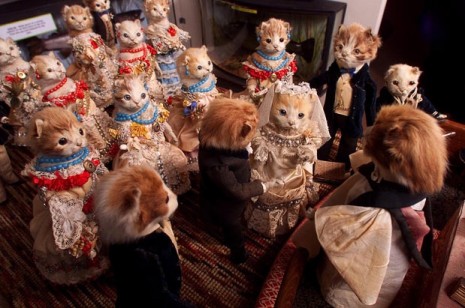
Do you, Mr. Whiskers, take Miss Kitty to be your
lawfully wedded dead puppet wife?
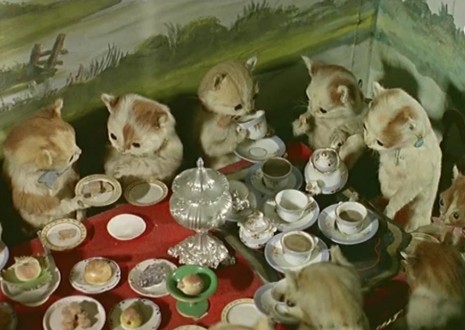
How are we holding these cups? We don’t have
opposable thumbs!
You think those stills are creepy??? Watch the video. My brain screamed What The FUCK?!? the first time I watched this clip, and it repeats that query (with the addition of Dear God, WHY???) every time I watch it again; which I must admit I can’t seem to stop doing. I honestly don’t know what it is about those stuffed cats and rabbits that I find so damned amusing. As abhorrent as they are, there is something cute about them too. They scare me, but they also make me want to get all cuddly. As soon as the video starts to play, its like Dr. Doolittle and Ed Gein are partying inside my brainpan.
I wonder what was in Potter’s pipe when he
decided to make this horrific shit?
--Psst, hey! What’d ya get on number 3?
--Fuck off, jack. Eyes on your own chalkboard.
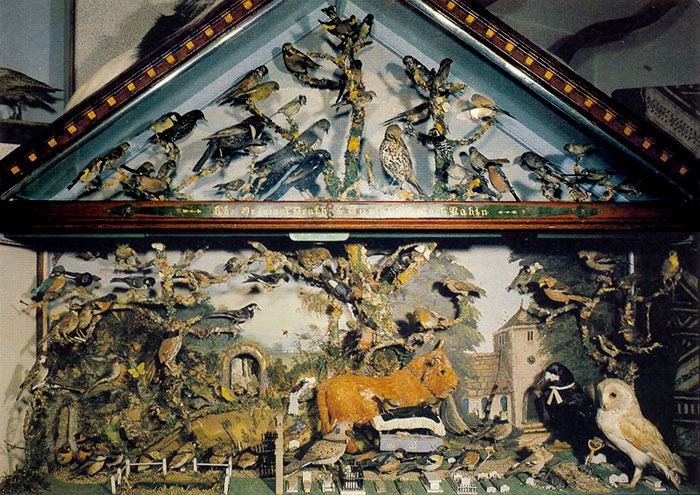
So who stuffed all these dead animals, and why? The guilty party is one Mr. Walter Potter, an English taxidermist who displayed these ghastly dioramas at his personal taxidermy museum in Sussex, England. Potter picked up taxidermy as a hobby after his pet canary died, and although his first attempt didn’t turn out too well he kept at it, in a workshop loft above his father’s stables. He was inspired by the Nursery Rhyme “Who Killed Cock Robin?” after his sister read it to him. He apparently took it quite literally, and after seven years of work he unveiled this monstrosity, aptly (if not somewhat illiterately) titled: The Dead and Burial of Cock Robin, in 1861.
Fuck me sideways, but that’s some creepy shit!
By 1880, Walter Potter had stuffed so many dead animals and created so many fucking freaky dioramas that he had to build a Museum of Curiosities to hold them all. And this is only the animals he stuffed as a hobby; he was also a professional taxidermist by trade at that point.

Potter died in 1918 when a small army of woodland animals tore him limb from limb in an attempt to liberate the desecrated bodies of their ancestors and relatives … God smote him for his abominations against the gentle creatures of the Earth… The great animal zombie outbreak of ’18 tore across the British countryside and all his creations rose from their scenes and perches to devour his brains…He finally succumbed to illness brought on by a stroke he had suffered a few years before. His museum contained approximately 10,000 animals at the time of his death, all taxidermied by Walter Potter.

I just have to ask… Do you think he really just happened to stumble across 10,000 dead animals over the course of his “hobby”, or was he responsible for an animal Holocaust?

In a perfect world, Potter would have been stuffed and mounted, but alas he was simply buried - although it was in the same graveyard he used as a model for his debut diorama.

Acknowledgments:
http://www.youtube.com/user/britishpathe
http://www.ravishingbeasts.com/walter-potter/
http://en.wikipedia.org/wiki/Walter_Potter

Saturday, September 3, 2011

Guest Blogger: Alex Lugo reviews "Some Unknown Gulf of Night"

The Cosmicomicon is proud to welcome back ace reviewer Alex Lugo, who offers up his review of W. H. Pugmire's latest inspired and fantastically original work Some Unknown Gulf of Night, which is, according to Bloodletting Press:  "One of only 100 signed and numbered hardcover copies. Cover and interior illustrations by Matthew Jaffe." 

Get your copy while it's still slippery and hot, and before it goes into a second printing, as everyone knows that owning a first printing copy of a legendary tome means your contributing greatly to your present and future sex life.  Because, as John Waters famously uttered, "If you go home with somebody, and they don't have books, don't fuck 'em."  Don't be caught dead - or trouserless - without treasures such as this adorning your creaking shelves.

So now, as I often do and hope to do for the unforeseeable future, I turn my pages over to Master Alex....
____________________________________________________________________________
 Some Unknown Gulf of Night
By W.H. Pugmire
Review by Alex Lugo

           Some Unknown Gulf of Night is the latest, strangest, and undoubtedly greatest book thus far from modern master of the weird tale, W.H. Pugmire. Before even getting into the story itself, one must really appreciate the production and design of the actual tome. It is a very small book, a tad bit bigger than the novella line from Delirium Books. I have always favored over-sized books, but I feel that the small size of the book does it proper justice. It gives off this appealingly ghoulish cuteness, if that makes any sense. The publisher is Arcane Wisdom, the weird fiction imprint of Bloodletting Press. I proudly possess all of the Arcane Wisdom titles, and the owner, Larry Roberts, always delivers a fine production. Some Unknown Gulf of Night is no exception. Along with all the other books of Arcane Wisdom, it has an extremely low print run. Only 100 limited edition copies are for sale, and nearly all of them are gone, so if my review tickles your fancy, you should hurry over to Horror Mall to secure your copy before they disappear into the night.

            Like most of Pugmire’s work, Some Unknown Gulf of Night is extremely Lovecraftian. What Pugmire does with this book is portray his own unique response to Lovecraft’s brilliant sonnet sequence, Fungi from Yuggoth. The book is split up into 36 numbered prose poems and vignettes spanning 191 pages, meaning this is Pugmire’s largest single work yet. Each segment is Pugmire’s own interpretation of that numbered sonnet from Fungi from Yuggoth. Many of the segments are connected, whether it is due to a recurring character, or a straightforward continuation of a previous segment. Other segments are standalone stories. My personal favorite was one of the standalone pieces, which centered upon a weird artist named John who inherits a house near Dunwich and is driven insane by the cosmic lunacy evoked by a strange photograph with which he is obsessed, and attempts to reproduce through his art. This madness carries over to his friend, who is the narrator of the segment. 
 
            Some Unknown Gulf of Night is not a book you read in one sitting. Although it is under 200 pages, the reader must think of the book as 36 different stories, each needing to be digested with the proper time, like a rich meal, served bloody and rare. To read it in one sitting is too much. There are segments in the book that are two pages long, but are so decadent and powerful that they alone have as much depth and wonder as a ten-page work. The brain of the lucky reader risks over-saturation, and the possible bursting of brain tissue, should they attempt to complete the tome in one, unbroken read, as Pugmire’s sumptuous and poetic style is something to be sipped slowly, like a fine aperitif. 

            While not absolutely essential, it will help if the reader is not only familiar with the Lovecraftian universe (as there are some explicit references to his places and characters), but also with Pugmire’s own richly crafted world as well, for there are many call-backs to Pugmire’s past work. For example, one of the most frequent characters is a red haired, black skinned girl (although oddly devoid of African features), who dons a yellow, silk dress. People familiar with Pugmire will know that this woman is Marceline, an avatar and soul-sister of Nyarlathotep himself.  If you are not familiar with both writers, you might be a bit confused when you read this book, although enjoyment is assured, be you Lovecraftian/Pugmire novice or well-read sage.
            
       Some Unknown Gulf of Night is a dream come true to fans of Lovecraft and fans of Pugmire. For the Lovecraft fan, you can expect all types of cosmic horrors, weird locales, and blessedly archaic phrasing. For the Pugmire fan, you can expect mentally deranged characters, beautiful prose, and disturbing atmosphere. What’s not to like? Gulf has a small page count, but it is thick with content. Gulf can be as disturbing as coming across a clown in the middle of the forest, but it can also be as beautiful as a misty Kingsport night. Gulf will disgust you, and caress you. It is a grand paradox of Lovecraft’s world, and Pugmire’s adoring view of it. I assure you that although this book is super Lovecraftian, it is beyond the realm of pastiche. Pugmire writes in a way Lovecraft never could, yet he pays homage to the master at the same time. It is something truly magickal and I honestly can’t explain it. The best way to discover those nighted and weirdly horrific things that Wilum H. Pugmire has carefully arranged in the shadowy corners is to pick up this fine work for yourself.  You won’t be disappointed, nor will you be the same when you close the book as you were when you first opened it.
____________________________________________________________________________

by Alex Lugo 

The Gorgeous Lovecraftian Legend

Friday, May 20, 2011

Guest Blogger: Jeffrey Thomas Reviews "Engines of Desire" by Livia Llewellyn

On this eve of long promised, righteous destruction, The Cosmicomicon continues its much talked about, days old tradition of bringing you the best guest bloggers working and lurking in the murky biz. 
This week is no different, as noted author/artist and Punktown creator Jeffrey Thomas (featured recently in Alex Luggo's guest blog review on pages prior) marvels at the roar and hum of Livia Llewellyn's widely celebrated Engines of Desire: 
____________________________________________________________________________
  
A Review of ENGINES OF DESIRE by Livia Llewellyn
- Jeffrey Thomas

     It’s no novel observation that it’s always exciting to discover a writer you’ve never read before; what greater satisfaction could account for one’s love of reading? Sometimes the pleasure comes from discovering someone others discovered quite a while before you. Last month, for instance, I completed BRAVE NEW WORLD, and in January I came across this guy named Cormac McCarthy. (I always feel a bit late to the game when it comes to movies and music, too -- but better than never, and all that.) Other times, the author you discovered is relatively new, or at least wholly new to you. Recently, writers who became favorites of mine with just one book were Richard Gavin (with OMENS) in 2009, Otsuichi (ZOO) in 2010, and Simon Strantzas (BENEATH THE SURFACE), earlier this year. And now, maybe not too late this time, here I am discovering Livia Llewellyn, via her new collection ENGINES OF DESIRE (Lethe Press).

     There’s a lot to admire here, and where to begin? I’m always impressed when a writer can work confidently within multiple genres or subgenres, and the stories in ENGINES OF DESIRE could be called a mix of horror, dark fantasy, science fiction -- though I wouldn’t blame Llewellyn if she’s as uncomfortable with such limiting categorizations as I am. Better to say, then, that she’s unfettered by genre. The stories tend to be either quite long or quite short, which again impresses; she’s going to let this story be the length it wants to be, whereas many other writers seem to weigh their efforts on the scale of whatever is going to fit the word range of the next zombie anthology. And where so many writers go through the motions of being shocking and edgy, Llewellyn makes them look like posers, writing as she does unflinchingly of infanticide, incest, madness and self-destruction. Her female protagonists are both empowered and compromised. Childbirth is a repeated subject matter, and repeatedly viewed not as a means of bringing joy and promise into the world but perpetuating the suffering of the doomed and damned.

     Among the standouts in these ten stories, we have the grim, apocalyptic “Horses” (and I’ll just stop introducing each story as grim right now -- that’s a given; this is not a feel-good bunch of tales), about a woman discovering the most basic imperatives of a human being, at the hour of human extinction; “The Engine of Desire,” a chilling tale of erotic obsession, the reading of which is like watching a film of a tornado brewing in reverse, from terrible aftermath to the first churning storm clouds; the increasingly nightmarish “Jetsam,” one of my favorites, about the resonance of 9/11; “The Four Hundred Thousand,” about a future civilization where young women are used to spawn whole armies that serve as a metaphor for the pointless sacrifices of war; the eerie, icky, enigmatic “Omphalos,” about the implosion of a most insular family; and easily my favorite, the concluding novella “Her Deepness.”

     “Her Deepness” is about as New Weird as New Weird can be, and again I hate categorizing here. That subgenre has been declared dead before it was even declared legitimate. I think some of those pronouncing it dead did so for their own purposes, owing to their competition with or envy of other authors whose future work they hoped to thwart by labeling it passé in advance. Politics, don’t you know. But categories do have their use when taken with a grain of salt, helping us stumble into the vicinity of things we’re going to like, and I was pleasantly surprised to find something of this particular flavor in Llewellyn’s book. “Her Deepness” could also be called Lovecraftian, but again that would be limiting it too much. It’s a dense, complex story about a sculptress with mysterious powers of shaping stone, called to the outer reaches of an impossibly vast, gritty, alternate Earth megalopolis to release a god-like being said to be trapped within rock, like some sentient fossil. In this tale most especially, Llewellyn indulges her considerable powers of description and setting, her ability to craft hard-edged characters who might not often be likable but are all the more fully real for that, her abundant and fresh imagination, her ability to generate an atmosphere heavy with a true sense of doom, and a prose voice full of glittering black poetry. Like many of the stories here, “Her Deepness” flirts with and ultimately plunges into the hallucinatory. It’s a heady experience. Forget I called it New Weird. Writing like this can never be passé, so I don’t want to run the risk of giving the wrong impression. I will say, I think Livia Llewellyn can hold her own alongside a China Mieville or a Jeff VanderMeer. I will say that much.

     And I will say this: I have another favorite writer. Ah…so this is why I read.

Tuesday, May 3, 2011

Guest Blogger: Alex Lugo reviews "Thought Forms" by Jeffrey Thomas

Going forward, The Cosmicomicon will feature up to four guest bloggers per month, to add some variety of content, a touch of the multimedia, as well as some slightly different viewpoints of similarly dark corners. 

Leading us off is book reviewer Alex Lugo, who serves as our debut guest blogger, giving us his thoughts on Jeffrey Thomas' latest novel Thought Forms, published by Dark Regions Press, a fantastic publisher of horror, fantasy and sci-fi that boasts a roster shot through by a number of familiar and fantastic names.

So now, without further ado, I turn the page over to Alex....
____________________________________________________________________________

Thought Forms by Jeffrey Thomas
Review by Alex Lugo

I think it’s safe to say that most readers of horror read horror to be horrified.  Sadly, most horror literature these days just doesn't have it. The horror, that is.  

Thought Forms is not one of those books. I can rightfully say that alongside Laird Barron's Mysterium Tremendum, Thought Forms by Jeffrey Thomas is the scariest piece of literature I have ever read in fourteen years. There are no clichés, no stupid moves by the main characters, and absolutely no predictability. Although Jeffrey Thomas is most famous for his Dark Science Fiction tales set in the universe of Punktown, this novel is an utterly supernatural tale set in eldritch Massachusetts. It is a story of two cousins, Ray and Paul. Both of these men have seemingly different problems, but creatively entwine once the stunning conclusion is revealed. 

At the very beginning of the story, we learn that Ray’s mother and father were butchered by some unknown force when he was very young. A little over twenty years later, Ray moves into the same house where he experienced the bloody slaying of his parents. Sounds kind of silly, but as you eventually learn, all of Ray’s memories of his parents are mainly comprised of drunkenness and abuse, hence he doesn’t feel that much discomfort living in the house where he parents were murdered, since he had no real emotional attachment to them. Instead, he considers his his Aunt and Uncle and his cousin Paul as his true family. Ray spends much of his time in the house drawing, taking care of a dog named Kelly, and firing his arsenal of guns in the surrounding woodlands. He works at a leather goods factory, and, for the first time in his life, begins to develop a romantic interest in a woman named Heidi. 

Everything seems to be going exceedingly well until one night, Ray and the dog notice a dark silhouette of some strange figure standing in his driveway, scrutinizing them with piercing, midnight eyes. And this is just the beginning...  As the days - and nights - pass, the visits from strange, shrouded  figures grow more common, brazen, and bizarre, while his affections for Heidi grow stronger. What originally seemed to be just some lost soul in his driveway morphs into something darker and more sinister, something that seems to be returning to continue a tradition of bloodshed that started over twenty years ago.  But what are they, these dark, silent figures?  What do they want, and why?

At the same time, Ray’s cousin Paul is going through an equally, if not stranger experience. Paul is an artistic individual, much like Ray, but delves into the more elaborate and fantastic with his work, unlike the realistic artwork of Ray. Paul is a self-proclaimed witch - not some attention-seeking, Goth buffoon, but a true worshiper of nature’s beauty and wonder. He works nights at a plastic factory, where he heads up an all-female team of workers.  The day goes by in a seemingly ordinary fashion, until word is spread that a worker saw the infamous factory phantom - a young, blond haired boy seen multiple times by a plethora of workers, including Paul himself, who just earlier in the day could have sworn he saw a similar blond child in the cafeteria. The strangeness builds when a sudden hush settles over the factory.  All is dead silence, save for the distant chatter of the radio on the factory intercom. After a brief inspection, Paul and his team discover that the factory is suddenly deserted, absent of all human life. Ideas spread like wildfire, but after a factory worker is found cowering under a multitude of boxes, near catatonic with fright, Paul knows something is utterly wrong. With every tense moment, Paul learns the terrible truth that some dark, horrid creature is stirring in the factory, a beast as monstrous and bizarre as one of his outlandish paintings.  A beast that is now hunting all those trapped inside the factory until morning. 

As both stories unfold, each cousin must face their own version of ultimate horror, as they come to grips with a mysterious, terrifying enemy devoted solely to their demise.

Thought Forms is many things: tense, horrifying, relentless, violent, magical, masterful, and absolutely wonderful. It is a novel best read under the veil of night. It is a tome so diabolical, I couldn’t read it alone, shamefully. Most importantly, in a time when most of the so-called horror books housed in your local book store fall short, Thought Forms is scary in a way that defines the term.  

Without giving much away, it will make you afraid to think what you think you might be thinking.  
____________________________________________________________________________

by Alex Lugo