Showing posts with label T.E. Grau Interview. Show all posts

Monday, November 23, 2015

Publishing and Interview News: T.E. Grau signs publishing deal with This Is Horror for new work in 2016, sits down for This Is Horror Podcast interview


Now that the cat is well out of the bag and skittering down the street, I may as well formally announce that I recently signed a publishing deal with This Is Horror for one, and possibly two, novellas to be published in mid 2016.

As for my reaction to the news, I think my quote available in the article says it best:
"I’m incredibly excited to announce my commission by This Is Horror to write a new work of fiction under their proud banner. 
In writing this book, I get the opportunity to work with Michael, Dan, and the whole This Is Horror crew, an outfit that seems to have exploded onto the scene with world-class works of contemporary horror fiction. Joining a roster that includes such names as Nathan Ballingrud, Ray Cluley, Gary McMahon, and Stephen Graham Jones is quite the honor, and I’m delighted by the opportunity. 
This will be my first release of new fiction after my debut collection The Nameless Dark, and I’m hoping my new work lives up to the incredibly high standard set by This Is Horror, with the aim of entertaining – and hopefully unsettling – the hell out of their readership."

In related news, I conducted an interview with Michael David Wilson and Dan Hovarth of the famed This Is Horror Podcast a few weeks back, and it just went live this afternoon. Follow this link and give a listen.

We covered a lot of ground, including my journey from fantasy to dark fiction, the horror of screenwriting, judging a book by its cover, the state of speculative fiction, my recent collection and upcoming works, the pros and cons of technology, why wives make the best editors, simplistic writing advice, the importance of reading Lawrence Block, Flannery O'Connor as literary Azathoth, and my unabashed love for most things British. And maybe a couple of other bits.

Give it a go if you have a spare hour, seven minutes, and forty-four seconds.

I'm excited and grateful to be hooked up with This Is Horror in 2016, and hope readers dig the new work. Stay close for more details as they become available.

In this podcast T.E. Grau talks about The Nameless Dark, screenwriting, technology, dark fiction and much more.

Show Notes:

[01:50] Interview start
[02:15] Initial interest in horror
[06:35] Screenwriting’s influence on fiction writing
[08:22] ‘Expat’
[10:10] Crossing genres
[15:00] The release of The Nameless Dark
[17:45] Cover art
[35:50] Writing process
[38:10] Best piece of writing advice
[43:50] Best things happening in dark fiction today
[53:20] Advantages and disadvantages of technology for writers and readers
[56:50] British scene
[58:10] New T.E. Grau release in 2016
[01:02:25] Connect with T.E. Grau
[01:03:00] Writers that intimidate Grau
[01:05:50] Competition time


Thursday, September 24, 2015

Blog About a Blog: Random-Ass Interview with Sean M. Thompson now live on horror site Spooky Bloggery


"Spooky Sean" Thompson of Spooky Bloggery, as well as Miskatonic Musings and From the Nether Regions fame, recently interviewed me, and took it live this morning.

Check out the Random-Ass Interview here, and tag that Spooky Bloggery joint for future interviews, reviews, news, and posts from around the weird-o-sphere. Sean is a stone cold Horror Hound, and a swell fellow, and I thank him for the interview invite.


Wednesday, September 18, 2013

Non-Fiction News: T.E. Grau Interviews Thomas Ligotti for Fiction Journal LORE - Death Poems Now, New Ligotti Fiction on the Bleak Horizon?


I love many modern Weird Fiction writers - and by "modern," I mean anyone distilling shadows and strangeness into ink from the early 20th century into this current toe tip in the 21st. We are currently blessed with a wonderful array of talented scribes, who incorporate all those delicious elements of great Speculative Fiction - the cosmic, supernatural, bizarre, uncanny, unsettling, unnameable, terrifying - into their short stories, novellas, and novels.

But there is no one currently putting word to the dark that can touch Thomas Ligotti.  He's The One for my generation.  The It.  He's our greatest living Weird/Horror Fiction writer.  And just as he was about to be crowned, he left the game.

Well okay, that's no entirely true.  He didn't leave the field by his own volition.  He was forced out, and put on injured reserve due to his ongoing battles with anhedonia, depression, and a few physical ailments, which rendered him psychologically unable to write the sort of stories he wrote.  This, in turn, left a stadium full of devoted fans to ponder a Weird Fiction future as grim as Ligotti's fiction as its greatest star was forced into an early retirement.  There would be no more tales of such profound oddness, darkness, and OTHERNESS for us to read and over which to marvel.  No more collections of short fiction during a time when the short form was being - and continues to be - stamped out by the Almighty Novel.  No more stories that can viscerally unsettle a reader in such a unique and subtle way, without falling back on the tired tropes and gratuitous gore that has sullied the Horror genre under the weight of their own overuse.  The betrayal of our ridiculously weak human form left our very best unable to continue adding to his incredibly rich corpore laboris, which seemed right out of a Ligotti story. 

He still undertook occasional non fiction and philosophical writing (see The Conspiracy Against the Human Race), as well as critical reviews and blurbs, but the streaming spigot of fiction has been all but shut off since 2006 with the release of Teatro Grottesco, which is notable as his last written and published collection of new works, after which an extended break from fiction writing evolved into the feared end of his creative writing career.  This was a tragedy, made selfish by us in our desire for more of his particular brand of magick, but mainly because such a gifted individual was unable to continuing doing what he was created to do as a result of the betrayal of the very consciousness he so often railed against (and in his case, for apparently good reason).  The always reclusive writer became all the more so, ghosting out of the literary world as he battled inside himself.  He was done with fiction, through a personal decision that was ironically not his to make.

Or so we thought...

In a recent interview I conducted with Thomas Ligotti for the acclaimed Horror/Fantasy/Sci-Fi journal Lore, he was his usual eloquent, profound, and famously pessimistic self, but also incredibly candid, sharing rare details of his ongoing struggles with psychological and physical ailments and their impact on his work, depression, suicide, as well as revealing that he has recently written several new works of short fiction.  Naturally, this blew me away, and excited devoted fans of Ligotti's work around the globe.

I will except a portion of the interview below, and encourage you to click on through this link to find the full discussion at the Lore website:
T.L.: I never abandoned fiction writing as a matter of principle or anything like that. My mental state just began to deteriorate after 2001. Then, within the space of a few minutes, my mood shot up and that lasted for about a month in late 2002. During that month, I wrote two stories. Afterward, my mood would usually improve late in each year. It was during those times that I worked on The Conspiracy against the Human Race beginning in 2003, because it hadn’t improved enough to write fiction, which takes a different sort of energy and motive, at least for me, than writing nonfiction. In 2005, I crashed completely and couldn’t even earn a living anymore as an editor. During upward mood swings, I continued to work on Conspiracy until it was finished in 2010. I apologize for giving this blow-by-blow account of my moods and literary production, but now that I’ve started I’m going to finish. In 2012, I suffered some severe physical traumas that had the effect of heightening my mood, and my imagination started to gradually make a comeback after dying in 2002. That’s the best way to explain it: After producing two stories in 2002, my imagination just died. Throughout 2012, the trauma I experienced kept elevating my mood and ambition. I wrote some new poems and started to compile a collection of my interviews. Matt Cardin will edit the interview book for publication by Subterranean Press and provide an introduction. In March 2013, my imagination resurrected itself for me to finish two new stories. I don’t know if I’ll write any more stories. I’ve always said that. But I really didn’t think I would think I would write again, since I haven’t been engage in anything like gainful employment since 2005. I want to write, because when I’m in the process of doing it feels as if there’s something standing between me and death. When I don’t have that, then I either suffer from death anxiety and panic attacks or my imagination is burned out by anhedonic bipolar depression and all I want to do is kill myself, which is a daunting proposition. The non-suicidal speak so cavalierly about suicide, as if anyone can do it anytime they want. But you really have to be in a very particular frame of mind to voluntarily attempt to die. More often, someone with the worst depression simply doesn’t feel good enough to kill himself. It just doesn’t seem like a solution. Anyway, after going under anesthesia three times in 2012, I realized that to be anesthetized to death is by far the best way to do it, like Edward G. Robinson in Soylent Green. A lot of anesthesiologists kill themselves, more than any other profession, or so I’ve read. I asked an assistant anesthesiologist about this, and she was very forthcoming about people in her profession having the know-how and access to the right drugs to die peacefully whenever they want. It seems so unfair that we all don’t have that advantage.

This is HUGE, folks.  Absolutely massive.  I'd wager most of us never thought we'd see the day when Thomas Ligotti would return to fiction, instead retiring from the trade like T.E.D. Klein.  But here we are, standing on the precipice of something new in the fiction department, as well as the promise of a book of collected interviews, overseen and edited by exceptional speculative fiction writer, religio/horror philosopher, and Lead Teeming Brain Matt Cardin.  For us fans, these are bright days awaiting the delivery of the deepest dark.

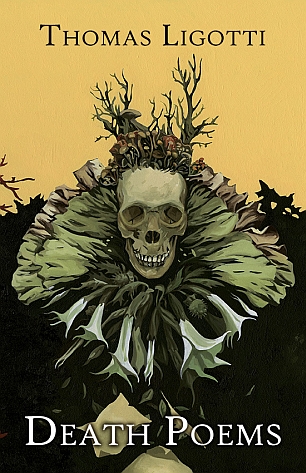
While we all anxiously await the release of his new fiction, we can slake our thirst with a pitcher of his classic poetic verse in Death Poems, originally published in 2004 by Durtro and now re-released by Bad Moon Books, featuring cover and interior art by the incredible Richard A. Kirk, who is a longtime collaborator with the likes of Clive Barker and Caitlin R. Kiernan.

From the Bad Moon Books website:
We are proud to announce the updated version of Death Poems by Thomas Ligotti, with a whole new section of poetry titled "Closing Statements". Cover art and internal illustrations by the amazing Richard A. Kirk. Long out of print, Death Poems was originally produced in a very small edition by Durtro in 2004. This highly prized collection has been virtually unobtainable until now. We expect this to sell out very quickly, so do not hesitate.

Wraparound dustjacket with internal illustration by Richard A. Kirk - See more at: http://www.badmoonbooks.com/product.php?productid=3621#sthash.HYs9xKKk.dpu
We are proud to announce the updated version of Death Poems by Thomas Ligotti, with a whole new section of poetry titled "Closing Statements". Cover art and internal illustrations by the amazing Richard A. Kirk. Long out of print, Death Poems was originally produced in a very small edition by Durtro in 2004. This highly prized collection has been virtually unobtainable until now. We expect this to sell out very quickly, so do not hesitate.

Wraparound dustjacket with internal illustration by Richard A. Kirk
 
So snatch up some TL poems (quickly, as this book WILL sell out, and become highly collectible, as are all this other works) and wait by the door, keeping your sweating palms firmly clamped over your ears to guard against that strange, soft knocking in the middle of the night.  The postman doesn't work after dark, but other things certainly do.

(Photos of the breathing tome below by Andrew Nevins, originally posted on Thomas Ligotti Online, and re-posted here at The Cosmicomicon with permission)


Tuesday, April 30, 2013

Editing News: T.E. Grau Named Managing Editor of Science Fiction Horror for Dark Regions Press, Which Launches First Dedicated Sci-Fi Horror Line in Independent Publishing


I am extremely proud to announce (via a headline written in the third person, something that makes T.E. Grau very uncomfortable) that I have been named Managing Editor of the new Science Fiction Horror line at Dark Regions Press, which - to my knowledge - is the very first dedicated Science Fiction Horror line to emerge in independent publishing.

I am a Horror fan, as a reader, writer, editor, and essayist.  As a thinker, and as a dreamer.  I like looking into the nighted places, and seeing what might be peering back.  And I've always been like this, as I think I'm just wired this way.  I don't believe that you can artificially engineer a Horror fan (although certain experiences or trauma can turn one's interest toward the shadows). Like handedness or an ear for music, you're either born with The Dark Curiosity, or you're not.

Being a Horror fan is simple enough to explain when discussing the topic with civilians, as they all picture a slasher film sequence throughout the whole conversation, or cheap Halloween props.  But when you hash out the subject with a fellow Horror acolyte, it gets a little more complicated, and a few initial parameters must be determined before the conversation can continue:  "Yes, you're a Horror fan, but WHAT KIND of Horror do you like?"

You see, Horror can be (and often is, for both better and worse) divided into numerous subgenres.  Starting with supernatural or non-supernatural, you break it down further into ghost stories, urban fantasy, Weird, zombie, cosmic, vampire, werewolf, psychological, subtle, folklore, splatterpunk, witchcraft, possession, etc... And then there are the slipstreamed mash-ups, that take us out toward infinity.  Each slot has its tropes and its fans, which means it has its loyalists.  And that's great, as loyalty to genre is what keeps alive the greater beast of Horror, propped up by a thousand pairs of tiny, disparate legs, all moving in a different direction, but all still keeping Horror upright and moving.

Horror isn't horror these days with its genres, and the genre I will be overseeing for Dark Regions Press is Science Fiction Horror.

You see, the more I learn about the Horror genre, the more I am understanding my place under this wide, wondrous tent.  I don't think I am a traditional (or conventional) Horror fan, as much as I am a fan of Weird fiction and Cosmic Horror, the latter of which is based in Science Fiction, of the kind practiced so well in the Pulp fictionists of the early 20th century.

As a devoted Cosmicist, I think about the sorts of short stories and novels I like to read, and the types of films I enjoy watching.  The Thing is my favorite horror film (followed by The Texas Chainsaw Massacre, which is more a traditional horror/slasher/chainsawy film).  H.P. Lovecraft is my favorite Horror/supernatural fiction author.  Of my modern writer peers, I prefer those who include at least a smattering of cosmicism in their stories, no matter how subtle.  It's not essential, but it does immediately catch my eye, and my interest.

So, to not put too fine a point on it, and without taking into account acumen or shortcomings, I feel that I was tailor made for this job, as Science Fiction Horror is my favorite type of genre horror Horror, more so than, say, Urban Fantasy or Splatterpunk or ghost stories.

To explain why, I'll let pictures do the typing...

This is Science Fiction Horror:


As is this:
And this:


And these guys:

And that handsome fellow over there to the right:


And those things:

Even this:
And especially this:


In fact, that last one is where Sci-Fi Horror all started, inside the mind of a teenage girl.  Now it's time for us to continue this proud heritage, of producing Horror stories infused with technology, alien influence, interstellar (and inner earth) exploration, experimentation gone wrong, runaway science, genetic tampering, doomsday following Doomsday...  This is Science Fiction.  This is Horror.  This is the new Science Fiction Horror line at Dark Regions Press.

Please find below an excerpt from a recently conducted interview with noted reviewer Justin Steele of The Arkham Digest, who was kind enough to let me share it here on the old TC mothership:

AD: Dark Regions Press is one of the most successful small press publishers, putting out quality work for over two decades. What are you bringing to the team? 
TEG:  I hope that I’m bringing a keen eye for quality writing, first and foremost.  I approach my position as not only an editor, but also as a writer of genre fiction, and a huge fan, as well.  I will seek out authors and help develop projects that I view as the best available from the ever-expanding pool of talent working in speculative fiction, both new and established.

I want to discover and secure the best in contemporary Science Fiction Horror Fiction, and cover art, adding to an already proud roster of DRP authors and impressive catalog of books.

AD: What kind of science fiction horror works for you? What are some examples of novels/short story collections and authors that hit what you feel to be the mark when it comes to the science fiction horror genre? 
TEG:  Something imaginative and bold, and not derivative at its core.  I’m not a big fan of bandwagon horror, where every new story sounds like the last, to take advantage of some marketing flashpoint or cultural trend.  I’m not looking for sparkling vampire stories or florid romance between supernatural creatures… in space.  I want something ORIGINAL and compelling.  I want something terrifying, and profoundly unsettling.  I want a great story, constructed of great prose, be it baroque or Spartan.  I’m a style hound, but those styles can vary, as long as the story is interesting, and appeals to our readership.

As for what authors of Science Fiction Horror might fit my ideal, my answer will be a bit hazy, as Dark Regions is one of the few - and possibly only - publishers that now has a stand-alone, dedicated department devoted solely to Science Fiction Horror, and only Science Fiction Horror.  Chris Morey wants to break new ground in this area, and I want to help him do just that, building the brand and helping add additional accolades to a strong, fair-dealing publisher devoted to bringing the best of speculative fiction to readers and the wider Horror, Fantasy, and Science Fiction marketplace.

So, back to the question:  I don’t want to name any particular authors, collections, or novels as my favorites, as I’m bound to leave someone out of my specific praise, so I’ll wuss out and default to the sorts of Science Fiction Horror films and television series that appeal to me, starting with John Carpenter’s The Thing, which is my favorite horror film of all time.  Other examples of great - or at the very least, interesting – Science Fiction Horror on the big and small screen include Alien, Frankenstein, The Mist, Planet of the Apes, Blade Runner, The Fly, War of the Worlds, Invasion of the Body Snatchers, Alien Nation, The Terminator, The Blob, old Japanese monster movies, 1950’s and 60’s American science fiction creature films, Dr. Who, Lost in Space, the original Land of the Lost and original V, The X-Files, and more recently, Cloverfield and Prometheus, although I had issues with both.  Zombie and post-apocalyptic films count, as well, as long as they have a definite futuristic/science fiction backbone.  Stories that echo some of these themes are all fair game, and will have my immediately interest.

And, as a proud reader, writer, and supporter of Lovecraftian fiction, I’m a sucker for Cosmic Horror, as long as its not Mythos-heavy pastiche.

AD: So as the managing editor of science fiction horror, what kind of work are you looking for?   
TEG:  I’m looking for anything that pushes the boundaries and has a unique voice.  Familiar tropes are okay, as it becomes increasingly difficult to create something 100% original as more and more stories are penned each day, but if the setting is prosaic, make what happens and by whom original and unique in some way.

It can be epic and galactic, or it can be small and intimate.  It can experimental, it can be slipstream, it can even be conventional, as far as setting and other tertiary elements.  It just has to sing.  Overall, I’m tough, but not a snob.  I enjoy a good breezy read as much as a deep, thought provoking piece, as long as it’s well written.  Now, describing what good fiction looks, sounds, and tastes like compared to bad is nearly impossible, but you certainly know both the former and the latter when you come across it.  I want to read – and DRP wants to publish - the good stuff, and won’t settle for anything less.

So, if you have a novel or novella that you think fits the bill, have someone put a bird in my ear.  We aren’t accepting general submissions, and will be operating by invite and referral only, so if I don’t know about an amazing work of Science Fiction Horror that needs to see the light of a dying sun, find a way to bring it to my attention, and I’ll take it from there.

AD: Do you have a "manifesto" or any goals that you've formulated going into this new position? 
TEG:  My main goal is to continue the tradition of excellence and success that Dark Regions Press has established and maintained for just shy of three decades.  That’s incredibly impressive.  As other indie presses have risen and fallen (sometimes in quite surprising and/or painful fashion), DRP has remained, and I take that decorated longevity very seriously in my mission to keep the brand vibrant and strong.

Following that, the ambitious editor in me would like to elevate – if possible – the quality of book that DRP puts out, from the inside out.  Even the best can always improve, and I think with the recent staff additions to the company (including R.J. Cavender of Cutting Block Press fame joining as Managing Editor of Horror), Dark Regions is looking to grow and advance, becoming a bedrock for the very best in Horror, Fantasy, and Science Fiction – and all the delicious amalgamations of the same – in the field today.  My manifesto is to make that happen, and I’ll be dogged in this pursuit.

Thanks again to Justin for inviting me to interview at The Arkham Digest, and allowing me to share a portion of our Q&A here.

NOTE TO AUTHORS:  I will be reaching out to various authors, to gauge their interest in producing something for the line, and/or to see if they have anything already written, currently in progress, or on the docket that would be appropriate.  And while I know many fantastic writers, I don't know them all, and there are so many talented scribes doing work that I have never read.

As such, I am accepting a limited number of queries for completed SFH novellas/novelettes/novels (no collections or anthologies at this time, please), sent to thecosmicomicon@yahoo.com.  If the brief synopsis looks like something we are looking for and/or sparks my interest, I will ask for an extended synopsis and a sample of the first three chapters.  At that point, I should know what I'm dealing with, and with whom.  As these query numbers are limited, I reserve the right to close them at any time, once I have enough/too many potential projects to work through.  They may or may not open back up again, depending on the quality and volume of queries I have received during this initial query period.  Dark Regions Press operates on an invite-only basis, but to get the SFH line started, I feel that I need to cast a wide net, at least initially, to see what's squirming around out there.

Let's be honest - publishers want to sell books, and books written by recognizable names will move better than unknowns.  BUT, what we want first and foremost are EXCEPTIONAL STORIES around which to wrap our label.  Properly prepared dung only burns hot for a brief second, like a cheap candle that lights up the room and gutters out, leaving a disagreeable odor behind.  Dark Regions Press has been and will remain in this industry for the long haul, and in this spirit, we want to put out the best books on the market, in all of our genres, which includes Science Fiction Horror.  Books that will endure, and help define (and possible re-define) contemporary Horror fiction.

A publisher is only as good as their authors (and artists).  DRP has published books from some amazing talents already, and now its time to continue this trend of quality going forward, which is where you just might come in.  Impress me.  Dazzle me.  Leave me terrified, or wonderstruck, or both.  Most of all, leave me wanting more.

I'm so very humbled and excited to be working for Dark Regions Press (joining the esteemed R.J. Cavender, DRP's new Managing Editor of Horror, in the dugout), and eager to get started.  Write hard, spread the word, and hit me up with the best that you've got.  The possibilities in Science Fiction and in Horror are endless, and endlessly fascinating.  Break me off something special, and let's tear down the sky.