Wednesday, October 30, 2013

TC Select Publishing: "Oil of Dog," by Ambrose Bierce


In preparation for publishing something truly spectacular in the coming days (you'll definitely want to stay tuned for this), and because Weird fiction writer Edward M. Erdelac recently suggested that I read this story after a brief discussion of the greatness of dark fiction founding father Ambrose Bierce, I'm publishing "Oil of Dog" (originally published in 1911) at The Cosmicomicon.

This is a public domain story, of course, so why not?  There are SO MANY amazing tales in the public domain - including all of the works of Lovecraft, REH, CAS, Blackwood, Machen, Poe, Hodgson, Chambers, and yes, Bierce - and others have published these works for decades, so why not me?  Why not here?  WHY NOT THE COSMICOMICON?

So, I give you....

"Oil of Dog"
by Ambrose Bierce

My name is Boffer Bings. I was born of honest parents in one of the humbler walks of life, my father being a manufacturer of dog-oil and my mother having a small studio in the shadow of the village church, where she disposed of unwelcome babes. In my boyhood I was trained to habits of industry; I not only assisted my father in procuring dogs for his vats, but was frequently employed by my mother to carry away the debris of her work in the studio. In performance of this duty I sometimes had need of all my natural intelligence for all the law officers of the vicinity were opposed to my mother's business. They were not elected on an opposition ticket, and the matter had never been made a political issue; it just happened so. My father's business of making dog-oil was, naturally, less unpopular, though the owners of missing dogs sometimes regarded him with suspicion, which was reflected, to some extent, upon me. My father had, as silent partners, all the physicians of the town, who seldom wrote a prescription which did not contain what they were pleased to designate as Ol. can. It is really the most valuable medicine ever discovered. But most persons are unwilling to make personal sacrifices for the afflicted, and it was evident that many of the fattest dogs in town had been forbidden to play with me — a fact which pained my young sensibilities, and at one time came near driving me to become a pirate.

Looking back upon those days, I cannot but regret, at times, that by indirectly bringing my beloved parents to their death I was the author of misfortunes profoundly affecting my future.

One evening while passing my father's oil factory with the body of a foundling from my mother's studio I saw a constable who seemed to be closely watching my movements. Young as I was, I had learned that a constable's acts, of whatever apparent character, are prompted by the most reprehensible motives, and I avoided him by dodging into the oilery by a side door which happened to stand ajar. I locked it at once and was alone with my dead. My father had retired for the night. The only light in the place came from the furnace, which glowed a deep, rich crimson under one of the vats, casting ruddy reflections on the walls. Within the cauldron the oil still rolled in indolent ebullition, occasionally pushing to the surface a piece of dog. Seating myself to wait for the constable to go away, I held the naked body of the foundling in my lap and tenderly stroked its short, silken hair. Ah, how beautiful it was! Even at that early age I was passionately fond of children, and as I looked upon this cherub I could almost find it in my heart to wish that the small, red wound upon its breast—the work of my dear mother—had not been mortal.

It had been my custom to throw the babes into the river which nature had thoughtfully provided for the purpose, but that night I did not dare to leave the oilery for fear of the constable. "After all," I said to myself, "it cannot greatly matter if I put it into this cauldron. My father will never know the bones from those of a puppy, and the few deaths which may result from administering another kind of oil for the incomparable ol. can. are not important in a population which increases so rapidly." In short, I took the first step in crime and brought myself untold sorrow by casting the babe into the cauldron.

The next day, somewhat to my surprise, my father, rubbing his hands with satisfaction, informed me and my mother that he had obtained the finest quality of oil that was ever seen; that the physicians to whom he had shown samples had so pronounced it. He added that he had no knowledge as to how the result was obtained; the dogs had been treated in all respects as usual, and were of an ordinary breed. I deemed it my duty to explain—which I did, though palsied would have been my tongue if I could have foreseen the consequences. Bewailing their previous ignorance of the advantages of combining their industries, my parents at once took measures to repair the error. My mother removed her studio to a wing of the factory building and my duties in connection with the business ceased; I was no longer required to dispose of the bodies of the small superfluous, and there was no need of alluring dogs to their doom, for my father discarded them altogether, though they still had an honorable place in the name of the oil. So suddenly thrown into idleness, I might naturally have been expected to become vicious and dissolute, but I did not. The holy influence of my dear mother was ever about me to protect me from the temptations which beset youth, and my father was a deacon in a church. Alas, that through my fault these estimable persons should have come to so bad an end!

Finding a double profit in her business, my mother now devoted herself to it with a new assiduity. She removed not only superfluous and unwelcome babes to order, but went out into the highways and byways, gathering in children of a larger growth, and even such adults as she could entice to the oilery. My father, too, enamored of the superior quality of oil produced, purveyed for his vats with diligence and zeal. The conversion of their neighbors into dog-oil became, in short, the one passion of their lives—an absorbing and overwhelming greed took possession of their souls and served them in place of a hope in Heaven—by which, also, they were inspired.

So enterprising had they now become that a public meeting was held and resolutions passed severely censuring them. It was intimated by the chairman that any further raids upon the population would be met in a spirit of hostility. My poor parents left the meeting broken-hearted, desperate and, I believe, not altogether sane. Anyhow, I deemed it prudent not to enter the oilery with them that night, but slept outside in a stable.

At about midnight some mysterious impulse caused me to rise and peer through a window into the furnace-room, where I knew my father now slept. The fires were burning as brightly as if the following day's harvest had been expected to be abundant. One of the large cauldrons was slowly "walloping" with a mysterious appearance of self-restraint, as if it bided its time to put forth its full energy. My father was not in bed; he had risen in his night clothes and was preparing a noose in a strong cord. From the looks which he cast at the door of my mother's bedroom I knew too well the purpose that he had in mind. Speechless and motionless with terror, I could do nothing in prevention or warning. Suddenly the door of my mother's apartment was opened, noiselessly, and the two confronted each other, both apparently surprised. The lady, also, was in her night clothes, and she held in her right hand the tool of her trade, a long, narrow-bladed dagger.

She, too, had been unable to deny herself the last profit which the unfriendly action of the citizens and my absence had left her. For one instant they looked into each other's blazing eyes and then sprang together with indescribable fury. Round and round, the room they struggled, the man cursing, the woman shrieking, both fighting like demons—she to strike him with the dagger, he to strangle her with his great bare hands. I know not how long I had the unhappiness to observe this disagreeable instance of domestic infelicity, but at last, after a more than usually vigorous struggle, the combatants suddenly moved apart.

My father's breast and my mother's weapon showed evidences of contact. For another instant they glared at each other in the most unamiable way; then my poor, wounded father, feeling the hand of death upon him, leaped forward, unmindful of resistance, grasped my dear mother in his arms, dragged her to the side of the boiling cauldron, collected all his failing energies, and sprang in with her! In a moment, both had disappeared and were adding their oil to that of the committee of citizens who had called the day before with an invitation to the public meeting.

Convinced that these unhappy events closed to me every avenue to an honorable career in that town, I removed to the famous city of Otumwee, where these memoirs are written with a heart full of remorse for a heedless act entailing so dismal a commercial disaster.

Tuesday, October 22, 2013

Publishing News: Short Story 'Beer & Worms' Selected for Best of The Horror Society 2013 Anthology, Now Available For Order Worldwide


Happy Tuesday to you, Weirdos, as we are now under tens days to go until the greatness of All Hallows Eve.  While I have you here, I'd like to take a moment to announce that my story "Beer & Worms" is now available in The Best of the Horror Society 2013 anthology, which went on sale October 15th, as unveiled by anthology editor Carson Buckingham and The Horror Society founder Scott Goriscak.

"Beer & Worms" is notable to probably no one else but me in that a) the title has been in my head since my early 20's (so, approximately 87 years ago), when I passed a hand painted bait shop sign out on the southwest Omaha hinterlands advertising this tantalizing combo nearly every night for several years; and b) it's my first piece completed for publication that moves away from the supernatural, sniffs nothing resembling the cosmic, and embraces a bit o' Noir (albeit in a very non-traditional Noir setting).  I call it "Cornfield Noir," and look forward to exploring similar stories in the coming days.  I hope this isn't giving too much away about the story.  It certainly might be, but regardless, I really enjoyed telling a dark tale that didn't rely on the crutch of the fantastical, which can always be conveniently utilized to get a writer out of a jam, or to artificially sweeten a plot that has more holes in it than the periwinkle mesh shirt my brother wore to the Motley Crue concert back in '86 (Theatre of Pain Tour, natch).


Here is the book description taken from the official CreateSpace (an offshoot of Amazon) ordering website:

A central coast trip that leads to devastating consequences for wine collectors. An adjoining hotel room that isn't what it seems. A long bus trip with a stopover in an eerie little town. You'll visit these places and more in this volume. Or how about the old woman with the strange plant? Or the odd little boy selling lemonade? Perhaps the sideshow lady who just smells so good? You'll meet them all at the turn of a page and they will remain with you long after the book is closed. The Best of the Horror Society 2013 is an anthology of the weird, the wonderful, and the downright wicked. Within you will discover not only the best of emerging horror writers but seasoned pros whose names you will no doubt recognize as well. So turn out the lights, pull up a chair beside the nearest roaring fireplace and enjoy the ride.

Please note the complete ToC below:

FORWORD - Scott M. Goriscak
INTRODUCTION - Carson Buckingham
CEREMONY - William F. Nolan
TENDRILS NEVER LIE - Kevin A. Ranson
THE MASK - Lisamarie Lamb
LEMMINAID - Carson Buckingham
THE CENTRAL COAST - Jason V. Brock
WHITE HELL, WISCONSIN - Weldon Burge
VICTIMIZED - Richard Thomas
NORMAL IS RELATIVE - Dan Dillard
THE PROCEDURE - Doug Lamoreux
THE LITTLE CHURCH OF SAFE CROSSING - Joe McKinney
MADELEINE - Julianne Snow
IT HAS TEETH - Christian A. Larsen
MASQUERADE - Dave Jeffery
BLACK BIRD - Rose Blackthorn
ADJOINING ROOMS - Scott M. Goriscak
THE INSPIRATION & HORROR OF GEORGE & HUGH - Nicholas Grabowsky
THE CLOWN - Henry Snider
MOVING DAY - Mark Onspaugh
ELLEN - Lee Pletzers
DADDY - Aaron Warwick Dries
SOFT LIKE HER - Charles Colyott
VENUS - L.L. Soares
THE LUMINOUS VEIL - Ian Rogers
BEER & WORMS - T.E. Grau
BLACK MARY - Mercedes M. Yardley
THE BOY IN THE ELEVATOR - Robert S. Wilson
WEIRD - Dean M. Drinkel
HOTTIES - Mort Castle

As you can see, this is a vast and varied line-up (28 STORIES!), and I'm pleased as pickled beets to be included in this anthology, sponsored by the nascent The Horror Society, which is a rapidly expanding collective of individuals who work in and support the Horror industry, from fiction to film to comics to fine art.

(my Horror Society profile featuring a seemingly cornball "pondering writer" pic - taken at a very non-cornball moment while Ivy and I were dining in Pike Place Market in Seattle - can be found here)

Please click on THIS LINK to order up 380 pages of the best Horror fiction written by some of the finest authors working in the genre today, and swing by The Horror Society on Facebook to join up.

Tuesday, October 1, 2013

TC Book Review & Interview: Bestselling Crime and Horror Fiction Author Michael Marshall Smith Returns to Speculative Roots with New Collection 'Everything You Need' from Earthling Publications

Cover Art by Vincent Chong

Not every author pounding the keys these days regularly receives accolades from the likes of Neil Gaiman and Graham Joyce, and fewer still have experienced major market success in dark fiction under two pen names that are remarkably similar, dropped surname or not.  But Horror writer Michael Marshall Smith (who writes as Michael Marshall for his Crime novels) isn't just any author.  He’s that rare breed of Bestseller who can hopscotch back and forth over often stubborn dividing lines in contemporary genre literature with the ease of playground children, collecting accolades every time his soles touch the ground.

After experiencing global success with his most recent crime novel, Killer Move (with his next, We Are Here, currently available in the UK, arriving stateside in 2014), Michael Marshall throws on the careworn Smith rucksack and burrows down into his Horror roots with the collection Everything You Need, published just last week by Paul Miller’s award-winning specialty press Earthling Publications.  Smith, who got his early start in radio comedy writing and performing for the BBC, moved into penning Horror in the early 1990’s, selling the first short piece he ever wrote, "The Man Who Drew Cats," which earned him a 1991 British Fantasy Award for Short Fiction in his debut outing.  Not a bad way to start a career, which only ascended from there, taking in numerous other honors (including four more British Fantasy Awards, an August Derleth Award, and a Phillip K. Dick Award) and critical accolades until the present day.

Which brings us to Everything You Need

This is a rich and varied collection, not just spanning genres, but breaking them in twos and threes, and sometimes committing the cardinal sin of not adhering to any at all.   The stories on the whole are dark and fantastical, often subtle, intensely thoughtful, even playful, with one piece embracing an interesting exercise in meta fiction.  In these eighteen well-crafted tales, Smith seems to work out all the demons that have been collecting in the basement, bringing to bear a muscled arm steeled by decades of writing acclaimed Speculative and Crime Fiction, further seasoned by fatherhood, marriage, and a move from the Old World to the New.  A knowing yet still refreshingly curious wisdom infuses these stories, making them at once relateable while simultaneously intensely innovative, drawing on themes and unsettling situations not easily mined by those who haven’t lived the way Smith has, done what he has done, seen what he has seen, either with his eyes open or closed.

As my reading time has been so limited lately, I worked through this collection slowly, taking it with me to various locations, reading in the morning, at lunch, and in the wee hours.  I can remember specific weeks, even months, based on certain stories read during those times.  We lived together for a bit, this collection and I, and when I was finished, it felt as if I had been through Something, emerging out the other end somehow altered, containing new, often unwholesome truths.  I had circumnavigated a queer but vaguely recognizable globe, taking in a vast array of heady sights, sounds, and disquieting sensations not commonly found in my own backyard… unless I did a little vigorous digging.  That’s a special kind of writing, able to replicate the familiar tinged with the profoundly alien and infinitely ominous.  This is the stuff of Michael Marshall Smith.

It is difficult to find a weak link in this group of three times six, and many of the stories are quite exceptional, stacking up against anything written today.  The book opens with "This Is Now," one of the best pieces in the collection in terms of creating pure dread based on weaving something unexplainable into the worn cloth of the commonplace.  Based on the interesting (and wonderfully illuminating) story notes included at the end of the book, my mind drew jittery conclusions about what was happening that didn't quite match up with what the author intended, which I'm sure would please him greatly.  "Unbelief" dips into Smith's reservoir of Crime, while "Walking Wounded" deals with a recurring theme of relationship issues, wrung through the author's unforgiving meat grinder.  "The Seventeenth Kind" shows Smith's humorous (spelled "humourous," I reckon) side with a creative, madcap satire of QVC, followed by a glimpse into another three letter world (OCD) via "A Place For Everything."

The next three stories - "The Last Barbecue," "The Stuff That Goes On In Their Heads," and "Unnoticed" - represent an incredibly powerful trio that gets to the meat of the collection, with the latter story vying for best of show.  "The Last Barbecue," paired together with "The Things He Said," share a similar foundational Horror subgenre that I (and pretty much everyone else these days) really enjoy, but which I won't spoil here.  Needless to say, they are two pieces bringing a refreshing melancholy to a trope easily buried under mounds of moldering flesh.  "The Stuff That Goes On In Their Heads" intensely resonated with me as a father, with a concluding stanza that is as devastating as it was unexpected.  "Unnoticed" just hums with Big W Weird, reading like a slow burn Ligottian headtrip, set in Smith's new home of Santa Cruz, California.  Creating unsettling situations without relying upon immediate threats, instead trusting the atmosphere and mood, is a very difficult thing to pull off successfully, but MMS knocks it out of the park.

The pace of textured storytelling continues unabated with "The Good Listener," which busts out of any confining genre, and stands proud as an ode to that peculiar distance that grows between most fathers and their ever-questing sons, who are so often forced to find out who their dad really was only after the old man is gone.  "Different Now" treads familiar Smithian ground of choices made and the looming specter of regret, becoming horrifyingly tangible in the form of labyrinthine London topography.  A very powerful piece that made me physically uncomfortable.  Set in a similar postal code is "Substitutions," which brings a "what if?" element to something as superficially mundane as home grocery delivery.

"Author of the Death" shows that the creation undertaken by writers doesn't necessarily stop when the computer is shut off or the manuscript goes to print, and playing God on the page isn't without residual consequence.  "Sad, Dark Thing" - the three word phrase suggested by noted editor and Smith's long time friend Stephen Jones - was the first story written by MMS about his new home in northern California, and it reads like he's been living there his whole life, exploring those dusty, forgotten roads between towering trees, unfortunately finding out where they eventually lead.  An honestly spooky story, which deftly gets to the marrow of good and classic Horror.

"What Happens When You Wake Up in the Night" garnered the British Fantasy Award in 2011, and it's easy to see why.  This is a bleak, terrifying tale, arresting in its originality (and simplicity), which once again draws from primal terrors born of a) a fear of the dark, and b) keeping safe one's family.  This story stayed with me long after I read it, and pops up often when waking up during the darkest, quietest times of the night.

The penultimate tale, "The Woodcutter," reads like an instant classic (or modern fairy tale?), and could anchor a much larger piece, set in the universe that this story creates.  It is interesting that the protagonist is a street magician working his trade in London, while the story itself was the very first started and completed from Smith's new home in the United States.  Sometimes it is easier to see a place half a world away, when the wider canopy fades into the ether, and the details never before noticed begin to emerge in the mind's eye.  The collection closes with the title piece, that again mines the subtle Weird, and leaves the reader walking away a bit dazed, totally impressed, and also a bit hopeful.  Again, another rarity in speculative fiction.

Overall, Everything You Need is aptly (knowingly?) titled, as the collection does indeed have it all for any fan of cerebral dark fiction.  Michael Marshall Smith proves that you certainly can go home again, and do so as a conquering hero returned, as long as that home contains a healthy amount of unnatural shadows and things that just... don't... quite... fit..
___________________________________________________________________________

I sent smoke signals up the great Pacific Coast Etherway, and Michael was lovely enough to check the skies and make a return fire of his own.  Please enjoy my conversation with this veteran writer, global traveler, and cross-genre celebrant who shows us all that tunnel vision in one's writing career can cut off so many unexpected vistas that are howling to be seen.

When writers write about writers (meaning, themselves), they all look like MMS in their heads.

First of all, thank you, Michael, for taking time to sit down across from this virtual, yet no less chipped Formica table to chat with The Cosmicomicon.  With the recent release of your anticipated collection Everything You Need, I know your time is in precious supply.

Let’s start off with a bit of background for the woefully uninitiated.  How and why did you begin your writing career?  Did you always know that you’d become a writer?

No. Actually, I thought I’d become an academic. My father had a distinguished career in that sphere, and my mother spent time there too — so I knew it could be a route to an interesting, engaged life, with plenty of time for family and possibly the opportunity to travel the world. I scribbled a few things when I was a kid, mainly because I was an enthusiastic reader, but it was writing comedy for Footlights shows at Cambridge university and then BBC Radio that started to open it up... along with the realization that in my chosen field, philosophy, I was always going to be riding with stabilizers on. Finally it was reading a Stephen King novel on a three-month theatrical tour that flipped the switch and told me that’s what I wanted to do. I wound up spending the rest of the tour reading everything of his I could lay my hands on, and by the end of it had the idea for my first story – THE MAN WHO DREW CATS. I saw a man doing a chalk drawing on the sidewalk in Edinburgh, where we were playing The Fringe, heard a child crying nearby, and the two collided into a story right there and then. It’s the hope of that kind of occasional gift from the gods that keeps you hooked...

Why Dark Fiction?  What is it about the dark stuff that shaped and/or directed your Muse?

I don’t know — it’s simply always been that way. I've tried to write material with nothing of darkness in it, but it doesn't compel me enough to keep going. I need the doors of reality to be pulled open a little wider — not for the sake of it, but because that’s how I believe the world is. Some people are that way, too. It’s possible it’s even genetic... my mother (already working a heavy job as head of social work in a London hospital) once took a year’s sabbatical to study for an MA in Death Ritual... and my sister has expressed consistent interest in becoming an undertaker. We’re a remarkably cheerful family in person, though...

You made your bones first in comedy writing and performing for BBC Radio, and then as an author of Horror/Genre Fiction, but have arguably achieved your greatest commercial successes in Crime Fiction with your more recent novels.  Was the expansion or shift from Horror to Crime intentional - or indeed, calculated - or more organic?  Asking the obvious, but is there a greater readership in Noir/Crime than Horror?  Why or why not?

There’s definitely a bigger crime/thriller readership than for horror, but that played no part in my thinking. There was no thinking: I lack whatever part of the brain you need for sensible career decisions, as my record proudly shows. I inadvertently made the switch when I wrote THE STRAW MEN. I’d wanted to write something about serial killers and conspiracies for a long time, and knew it wouldn't be as strong or credible if it was set in the future, as it might distance readers from the reality — so I set it in the present day instead. I also toned down the humour a lot, as it wasn't inappropriate to the subject.

Aside from that, I didn't see any real difference to what I’d been doing before... but publishers and (some) readers sure as heck did, hence the name change and an apparent swerve of genre. I've been trying to get back to more general dark fiction ever since... The thing about writing for a living is that there aren't many roads across the terrain, and you can have to drive a looooong way around to get back to where you started. In the meantime I've simply tried to write stuff I care about, and books I feel I can stand by.

Your first published short story, “The Man Who Drew Cats,” garnered a British Fantasy Award in 1991.   Quite an auspicious debut.  Did that put pressure on you to deliver right away on your next published tale?  Was the “sophomore slump” a concern?

To be honest, I was so surprised and so gung-ho that any pressure washed over me — and of course I’d already written a few more stories in the meantime. Those early years were very exciting: I didn't know what I was doing, and tried to place no limitations on what I wrote, or to care about what was going to happen. I wrote whatever popped into my head, and then moved on — often not even bothering to try to place the stories for months or even years afterwards. I've still got a couple of pieces from back then that I've never tried to sell.

Second Novel Syndrome, on the other hand.... yi yi yi. That was tough. Writing SPARES nearly finished me off. Sadly, I've learned since about Fourth Novel Syndrome, and Seventh, and Eighth...

How has the genre fiction writing industry and readership changed from the early 1990’s?  By all accounts, the explosion of popularity in Horror Fiction of the 80’s had pretty much withered under the haze of hippy/grunge in the 90’s.  Were you concerned about the changing marketplace once you had arrived as one of the bright new voices in Speculative Fiction?

I have always been a complete numbskull when it comes to commercial awareness, and have never thought about any of those issues clearly. The 1980s were big times for horror, yes — so of course I wrote three kinda-SF novels instead. Horror imploded as a novel format, except for the heavy-hitters... but it will be back. We need horror. We believe in it more than just about anything else. And I mean proper horror, not this teen nonsense currently in vogue. A large part of me still hankers to settle down to the big horror novel I assumed I was getting into the business to write... and which I still somehow haven’t even attempted. In the meantime I’m exploring the boundaries around thriller and suspense and the otherworldly... I tend to wander through the forest to see what’s there, rather than in hopes of getting anywhere in particular. You have to care about the marketplace, of course, but to be honest I’m not hoping for bestsellerdom when I write... I just feel lucky to be published at all.

Who are some of your favorite writers (living, dead, and somewhere in between), and who do you think influenced you most (as fave authors aren't always the most influential)?

Favorite authors would be Stephen King, Ray Bradbury, Philip K Dick, James Lee Burke, Jim Thompson, Richard Ford, Jack Finney, and doubtless many more... I’d be hard-pressed to work out which have exerted an actual influence — it’s easier for others to do that — and it’s changed over time. Ramsey Campbell and Nicholas Royle in the early horror years, Bradbury and Douglas Adams with the sf, then Burke/Ellroy/Thompson when I got to mystery... But I also think it works by you picking up the little touches that make sense to a style you’re already working toward, long before you know what it is.

Discuss briefly some of your peers that were around in the beginning of your career, and either are still hammering away, or have faded into the eaves.

The first and most important peer was one of the greatest living dark fiction short story writers, Nicholas Royle. We met by chance when I went to work at a company he was leaving. He’d already published a slew of stories and was a huge help as mentor and inspiration — not to mention becoming a great friend. I met Mark Morris soon afterward, and Conrad Williams, and Kim Newman, Christopher Fowler... and of course Stephen Jones, who has ended up being an extraordinarily important part of my life.

Everybody’s still working. We have good years, and bad years, and you treat both those impostors the same. That’s the job.

I know you’re close with renowned editor Stephen Jones.  How did this relationship start, and how has it grown since the beginning?

Steve and I got on pretty well from the start, though obviously I was kind of in awe of such a legendary figure in the field. We met at the London British Fantasy Convention where I was nominated for THE MAN WHO DREW CATS – a story he’d published for his re-imagining of the Pan Books of Horror, under the name Dark Voices. Since then we've started to work on more and more together — film stuff, design, and lately conventions. When Paula and I were considering moving out family to California, Steve was the one person who I knew I’d be seeing less often, and the thought gave me serious pause: there’s no-one in the world I’d rather hang out in a pub with. Luckily we’re both fluent emailers, so things are ticking over despite the miles...

In Everything You Need, your stories run the gamut, from Science Fiction Horror to quieter personal pieces, Noir and the straight-up Weird, to the darkly comedic.  Did you set out to write under a theme or genre when you started putting these stories together?  Did you intentionally go back to your Horror roots for this book, or are these just the stories that flowed out of your pen--  er, fingers when you sat down to write?

These are just the stories that have come. It’s quite a different collection to my first one, as I write many fewer big narrative pieces these days... the stories tend to be shorter, and far more varied in tone and style. I guess the big ideas often end up in the novels, and what I’m seeking is an outlet for more oblique and experimental ideas, moods and tones.

Your geographic background is quite varied, with a childhood spent in the United Kingdom, United States, South Africa, and then back to the UK, before emigrating to the central California coast a few years back.  Moving from your adult life in London to the U.S., how do you find the New World in the 21st century?  Does settling down in America give you new fodder from which to construct stories?

America has always felt like a second home — and also where I go to dream. Apart from ONLY FORWARD, my first novel, all the books have been set here. In a way, being here makes it harder: instead of relying upon memory and imagination (where I’m often happiest) I’m surrounded by reality which needs reflecting properly, too. That’s a new challenge. I dealt with this by writing a novel set mainly in New York City, while living in Santa Cruz on the other side of the country... You can’t say I’m not perverse.

From a cross-Pond/outsider’s perspective, what is it about the English that seem to embrace and propagate the bizarre and unusual?  More to the topic, do you think there is a difference in British and American writers and their handling of matters of the Dark?


The English certainly do love the shadows, and have a particularly unsettling and insidious way with them. Who knows why that is... maybe the weather. Or the dark Celtic genes. Or indigestion. There’s definitely a difference in how we end up manifesting the bizarre: I’m not sure America could have produced an M. R. James or Ramsey Campbell.... but on the other hand, England couldn't have given the world a Stephen King or Ray Bradbury. There’s great stuff coming from both sides...

You've garnered as many or more awards than most any other Speculative Fiction scribe currently working.  What is left for you to accomplish?  What are you still striving for as a writer?  What fuels you to put ink to paper?

It’s lovely to receive awards, of course, but they’re for things I've already done. You have to keep moving on. I want to write more books, better books, different kinds of books. I want to keep trying to do what I've always attempted — to move people, and explore ideas about what kind of people we are, and to make shit up in a way that transports people for a little while. And to the side of that, but equally importantly, I’m fueled by the need and desire to support my family. Art’s a great thing. So are stories. But feeding and housing the people you love are far more important.

As a professional author who has been successfully writing full time for years, and surely trotted around the block a few times, what advice can you give beginning or part-time writers who seek to make it a career rather than merely an after-hours pursuit?

I wish I knew. The best I can come up with is that if you want to do it, you should do it. Write. Read. Write and read some more. Be open to what the market says it wants, but also be vigilant about making sure you’re true to what you want, too – because in the end you’ll be both more distinctive and happier that way. This approach may stop you having a bestselling career (which we’d all love, of course) but writing should only be a part of your life, even if you’re doing it full time. Being there for your family and friends, and being happy or at least content... that’s going to seem a damned sight more important when you’re lying on your final bed and the darkness starts to seep in around you.

What can you tell us about Ememess Press?  From where did its unusual name originate?

The name is pretty simple — a phonetic way of writing “MMS”, for Michael Marshall Smith. It’s also my Twitter handle. The idea there was to find a way of putting some of the eighty-some short stories I've had published back out into the world, to give them an extra life. The short form is the lifeblood and backbone of horror and dark fiction, and it seemed a shame they were just languishing there on the hard drive... it’s been really nice to get feedback from people who hadn't read them before.

Where do you see Horror going as a genre?  What is the future, as you see it?  The usual tropes have been run into the ground, and then dug up again and again.  How can Horror Fiction widen its appeal, or should it?

I simply don’t know. You’re right, the tropes have been flogged to near-exhaustion, especially vampires and zombies... but there will always be something new to say about them in response to changes in society: one of horror’s great strengths is that it has always been a socially-informed genre, one which reflects and interprets and illuminates what’s going on around us. Blatant commercial over-mining may cause certain ideas to be run into the ground from time to time, but you can’t keep a good trope down... sooner or later they’ll rise from the grave, with new things to say and new ways of scaring us. Horror widens its appeal by writing better and more widely-accessible books, by proving it’s worthy of the attention that ‘literary’ or ‘mainstream’ critics and readers often deny it.

What’s next for Michael Marshall Smith, or even that bastard Michael Marshall?

Well, MM is supposed to be working on the next novel, and kind of is, though I’m deliberately standing aside from it at the moment, as I’m not happy with its core. MMS has been bubbling under for a while, and is getting impatient for more time in the sun. I've written something on the side over this summer which would come out under that name, assuming it ever sees the light of day... it’s not sf, but it is pretty damned zany. We’ll see if I can get anyone interested... I hope so. I’m often asked when I’ll start writing more MMS stuff, but the truth of it is that it’s a lot harder to get that kind of story published now than when ‘he’ was working full-time. The market has rigidified... I was lucky to write the MMS novels when I did.

So, what’s the deal with English food?  Deserved of its reputation, or is that a bunch of bollocks?  And do Brits actually drink room temp beer?

Ha :-) For a long time, English food was indeed pedestrian (though you could say the same of large swathes of the mid-West, too, right?) In the last couple of decades it’s kicked up a lot of levels, however, and now — especially with institutions like gastropubs, which have no real parallel in the US — I believe the country could go toe-to-toe with most (except France, obviously). There are indeed a lot of English beers that are meant to be drunk at room temperature, but I've never been a fan. I’m much happier with the cold-served Ambers and IPAs of the Pacific Northwest and Northern California...of which, thankfully, there are many. In fact, I might have one now.
The word Smith, right where he belongs.
Thank you again, Michael.  The Cosmicomicon wishes you a boatload of success for Everything You Need, and all of your books before and after.

(c) 2013 by Vincent Chong

Wednesday, September 18, 2013

Non-Fiction News: T.E. Grau Interviews Thomas Ligotti for Fiction Journal LORE - Death Poems Now, New Ligotti Fiction on the Bleak Horizon?


I love many modern Weird Fiction writers - and by "modern," I mean anyone distilling shadows and strangeness into ink from the early 20th century into this current toe tip in the 21st. We are currently blessed with a wonderful array of talented scribes, who incorporate all those delicious elements of great Speculative Fiction - the cosmic, supernatural, bizarre, uncanny, unsettling, unnameable, terrifying - into their short stories, novellas, and novels.

But there is no one currently putting word to the dark that can touch Thomas Ligotti.  He's The One for my generation.  The It.  He's our greatest living Weird/Horror Fiction writer.  And just as he was about to be crowned, he left the game.

Well okay, that's no entirely true.  He didn't leave the field by his own volition.  He was forced out, and put on injured reserve due to his ongoing battles with anhedonia, depression, and a few physical ailments, which rendered him psychologically unable to write the sort of stories he wrote.  This, in turn, left a stadium full of devoted fans to ponder a Weird Fiction future as grim as Ligotti's fiction as its greatest star was forced into an early retirement.  There would be no more tales of such profound oddness, darkness, and OTHERNESS for us to read and over which to marvel.  No more collections of short fiction during a time when the short form was being - and continues to be - stamped out by the Almighty Novel.  No more stories that can viscerally unsettle a reader in such a unique and subtle way, without falling back on the tired tropes and gratuitous gore that has sullied the Horror genre under the weight of their own overuse.  The betrayal of our ridiculously weak human form left our very best unable to continue adding to his incredibly rich corpore laboris, which seemed right out of a Ligotti story

He still undertook occasional non fiction and philosophical writing (see The Conspiracy Against the Human Race), as well as critical reviews and blurbs, but the streaming spigot of fiction has been all but shut off since 2006 with the release of Teatro Grottesco, which is notable as his last written and published collection of new works, after which an extended break from fiction writing evolved into the feared end of his creative writing career.  This was a tragedy, made selfish by us in our desire for more of his particular brand of magick, but mainly because such a gifted individual was unable to continuing doing what he was created to do as a result of the betrayal of the very consciousness he so often railed against (and in his case, for apparently good reason).  The always reclusive writer became all the more so, ghosting out of the literary world as he battled inside himself.  He was done with fiction, through a personal decision that was ironically not his to make.

Or so we thought...

In a recent interview I conducted with Thomas Ligotti for the acclaimed Horror/Fantasy/Sci-Fi journal Lore, he was his usual eloquent, profound, and famously pessimistic self, but also incredibly candid, sharing rare details of his ongoing struggles with psychological and physical ailments and their impact on his work, depression, suicide, as well as revealing that he has recently written several new works of short fiction.  Naturally, this blew me away, and excited devoted fans of Ligotti's work around the globe.

I will except a portion of the interview below, and encourage you to click on through this link to find the full discussion at the Lore website:
T.L.: I never abandoned fiction writing as a matter of principle or anything like that. My mental state just began to deteriorate after 2001. Then, within the space of a few minutes, my mood shot up and that lasted for about a month in late 2002. During that month, I wrote two stories. Afterward, my mood would usually improve late in each year. It was during those times that I worked on The Conspiracy against the Human Race beginning in 2003, because it hadn’t improved enough to write fiction, which takes a different sort of energy and motive, at least for me, than writing nonfiction. In 2005, I crashed completely and couldn’t even earn a living anymore as an editor. During upward mood swings, I continued to work on Conspiracy until it was finished in 2010. I apologize for giving this blow-by-blow account of my moods and literary production, but now that I’ve started I’m going to finish. In 2012, I suffered some severe physical traumas that had the effect of heightening my mood, and my imagination started to gradually make a comeback after dying in 2002. That’s the best way to explain it: After producing two stories in 2002, my imagination just died. Throughout 2012, the trauma I experienced kept elevating my mood and ambition. I wrote some new poems and started to compile a collection of my interviews. Matt Cardin will edit the interview book for publication by Subterranean Press and provide an introduction. In March 2013, my imagination resurrected itself for me to finish two new stories. I don’t know if I’ll write any more stories. I’ve always said that. But I really didn’t think I would think I would write again, since I haven’t been engage in anything like gainful employment since 2005. I want to write, because when I’m in the process of doing it feels as if there’s something standing between me and death. When I don’t have that, then I either suffer from death anxiety and panic attacks or my imagination is burned out by anhedonic bipolar depression and all I want to do is kill myself, which is a daunting proposition. The non-suicidal speak so cavalierly about suicide, as if anyone can do it anytime they want. But you really have to be in a very particular frame of mind to voluntarily attempt to die. More often, someone with the worst depression simply doesn’t feel good enough to kill himself. It just doesn’t seem like a solution. Anyway, after going under anesthesia three times in 2012, I realized that to be anesthetized to death is by far the best way to do it, like Edward G. Robinson in Soylent Green. A lot of anesthesiologists kill themselves, more than any other profession, or so I’ve read. I asked an assistant anesthesiologist about this, and she was very forthcoming about people in her profession having the know-how and access to the right drugs to die peacefully whenever they want. It seems so unfair that we all don’t have that advantage.

This is HUGE, folks.  Absolutely massive.  I'd wager most of us never thought we'd see the day when Thomas Ligotti would return to fiction, instead retiring from the trade like T.E.D. Klein.  But here we are, standing on the precipice of something new in the fiction department, as well as the promise of a book of collected interviews, overseen and edited by exceptional speculative fiction writer, religio/horror philosopher, and Lead Teeming Brain Matt Cardin.  For us fans, these are bright days awaiting the delivery of the deepest dark.

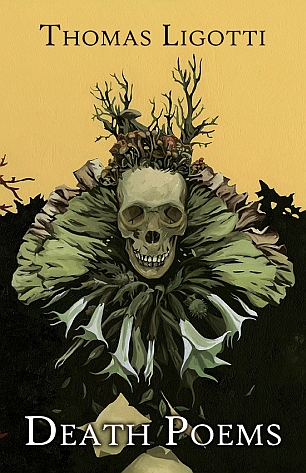
While we all anxiously await the release of his new fiction, we can slake our thirst with a pitcher of his classic poetic verse in Death Poems, originally published in 2004 by Durtro and now re-released by Bad Moon Books, featuring cover and interior art by the incredible Richard A. Kirk, who is a longtime collaborator with the likes of Clive Barker and Caitlin R. Kiernan.

From the Bad Moon Books website:
We are proud to announce the updated version of Death Poems by Thomas Ligotti, with a whole new section of poetry titled "Closing Statements". Cover art and internal illustrations by the amazing Richard A. Kirk. Long out of print, Death Poems was originally produced in a very small edition by Durtro in 2004. This highly prized collection has been virtually unobtainable until now. We expect this to sell out very quickly, so do not hesitate.

Wraparound dustjacket with internal illustration by Richard A. Kirk - See more at: http://www.badmoonbooks.com/product.php?productid=3621#sthash.HYs9xKKk.dpu
We are proud to announce the updated version of Death Poems by Thomas Ligotti, with a whole new section of poetry titled "Closing Statements". Cover art and internal illustrations by the amazing Richard A. Kirk. Long out of print, Death Poems was originally produced in a very small edition by Durtro in 2004. This highly prized collection has been virtually unobtainable until now. We expect this to sell out very quickly, so do not hesitate.

Wraparound dustjacket with internal illustration by Richard A. Kirk
 
So snatch up some TL poems (quickly, as this book WILL sell out, and become highly collectible, as are all this other works) and wait by the door, keeping your sweating palms firmly clamped over your ears to guard against that strange, soft knocking in the middle of the night.  The postman doesn't work after dark, but other things certainly do.

(Photos of the breathing tome below by Andrew Nevins, originally posted on Thomas Ligotti Online, and re-posted here at The Cosmicomicon with permission)


Wednesday, May 22, 2013

Publishing News: "The Truffle Pig" Accepted for Publication in 'Tales of Jack the Ripper', edited by Ross E. Lockhart, to be released Autumn 2013 by new press Word Horde

Cover art by Arnaud de Vallois

I am pleased as 198 proof punch to announce that "The Truffle Pig," my humble piece of Victorian Lovecraftiana, was accepted for publication in Tales of Jack the Ripper, an anthology edited by Ross E. Lockhart, the release of which will christen his new indie press Word Horde this coming autumn of 2013.

Ross is an acclaimed and widely respected writer and editor, probably best known for editing the excellent Book of Cthulhu (I & II) series, which was released by now-defunct (for all intents and purposes) Night Shade Books - the demise of which I will not go into here, as it is messy and complicated and most of all, unfortunate, in regards to the stellar stable of writers working under the Night Shade Books banner, and the readers who enjoyed NSB books (myself very much included).

So, back to the topic at hand...  All writers with any sort of professional aspirations have goals, and those goals are forever moving, based on the landscape ahead, and what real estate squats in the rear view.  With that said, ever since I first cracked open the first Book of Cthulhu, I've wanted to appear in one of Ross' books, as they always bleed quality, from the inside out, featuring the best writers in books that are solidly designed (cover, graphics, layout, font, paper quality, etc.), while still somehow managing a reasonable price.  I don't know how Ross does it, but he does, and now - thanks to my acceptance into Tales of Jack the Ripper - I get to be a tiny part of that, which thrills me to no end.  Goal achieved.

Please note the Word Horde Press Release, viciously cut and pasted - and adorned with snazzy linkage - below, together with the recently released ToC, that puts my story amongst some incredibly august company.  I'm just excited and honored beyond words to be a part of this anthology, and cannot wait to hold it in my small, girlish hands this fall.
___________________________________________________________________________

Press Release: Jack the Ripper to return fall 2013

1888: One hundred and twenty-five years ago, a killer stalked the streets of London’s Whitechapel district, brutally–some would say ritualistically–murdering five women (that we know of): Mary Ann Nichols, Annie Chapman, Elizabeth Stride, Catherine Eddowes, and Mary Jane Kelly.

The story of Jack the Ripper captured lurid headlines and the public’s imagination, and the first fictionalization of the Ripper killings, John Francis Brewer’s The Curse Upon Mitre Square appeared in October of 1888, mere weeks after the discovery of Jack’s first victim. Since then, hundreds of stories have been written about Bloody Jack, his victims, and his legacy. Authors ranging from Marie Belloc Lowndes to Robert Bloch to Harlan Ellison to Roger Zelazny to Alan Moore have added their own tales to the Ripper myth. Now, as we arrive at the quasquicentennial of the murders, we bring you a few tales more.

From Word Horde and the editor who brought you The Book of Cthulhu and The Book of Cthulhu II comes Tales of Jack the Ripper, featuring new and classic fiction by many of today’s darkest dreamers, including Laird Barron, Ramsey Campbell, Ed Kurtz, Joe R. Lansdale, Joseph S. Pulver, Sr., Stanley C. Sargent, E. Catherine Tobler, and many more.

Table of Contents

Whitechapel Autumn, 1888 – Ann K. Schwader
A Host of Shadows – Alan M. Clark and Gary A. Braunbeck
Jack’s Little Friend – Ramsey Campbell
Abandon All Flesh – Silvia Moreno-Garcia
The God of the Razor – Joe R. Lansdale
The Butcher, The Baker, The Candlestick Maker – Ennis Drake
Ripping – Walter Greatshell
Something About Dr. Tumblety – Patrick Tumblety
The Truffle Pig – T. E. Grau
Ripperology – Orrin Grey
Hell Broke Loose – Ed Kurtz
Where Have You Been All My Life? – Edward Morris
Juliette’s New Toy – Joseph S. Pulver, Sr.
Villains by Necessity – Pete Rawlik
When the Means Just Defy the End – Stanley C. Sargent
A Pretty for Polly – Mercedes Yardley
Termination Dust – Laird Barron
Once November – E. Catherine Tobler
Silver Kisses – Ann K. Schwader

Tales of Jack the Ripper is coming fall 2013 from Word Horde

$15.99 Trade Paperback: 978-1-939905-00-0
Ebook also available

Cover Art by Arnaud de Vallois

To request a copy for review or arrange an interview, email publicity@wordhorde.com.

Word Horde – PO Box 2074 – Petaluma, CA 94953-2074 – www.wordhorde.com


Praise for Ross E. Lockhart’s The Book of Cthulhu and The Book of Cthulhu II:

“The enduring allure of H.P. Lovecraft’s Cthulhu Mythos, now nearly a century old, is evident in this representative anthology of modern tales, most of which were written in the last decade. The breadth of cosmic horrors they evoke range from the parochial fear of monsters found in Michael Shea’s ‘Fat Face,’ to the apocalyptic doom forecasted in Ramsey Campbell’s ‘The Tugging.’ Some of the stories, notably Brian Lumley’s ‘The Fairground Horror’ and Brian McNaughton’s self-consciously satirical ‘The Doom that Came to Innsmouth,’ are ripe with Lovecraftian references. Most others, including Joe R. Lansdale’s weird western ‘The Crawling Sky’ and Laird Barron’s backwoods monster tale ‘The Men from Porlock’ (original to the book), are more oblique and allusive. To the book’s credit, none of the twenty-seven stories read like slavish Lovecraft pastiche, which makes this volume all the more enjoyable.” -Publishers Weekly (Starred Review)

“Gathering Cthulhu-inspired stories from both 20th and 21st-century authors, this collection provides such a huge scope of styles and takes on the mythology that there are sure to be a handful that surprise and inspire horror in even the most jaded reader.” -Josh Vogt, Examiner.com

“There are no weak stories here–every single one of the 27 entries is a potential standout reading experience. The Book of Cthulhu is nothing short of pure Lovecraftian gold. If fans of H. P. Lovecraft’s Cthulhu mythos don’t seek out and read this anthology, they’re not really fans – it’s that simple.” -Paul Goat Allen, BN.com

“…thanks to the wide variety of contributing authors, as well as Lockhart’s keen understanding of horror fiction and Lovecraft in particular, [The Book of Cthulhu] is the best of such anthologies out there.” -Alan Cranis, Bookgasm.com

“The Book of Cthulhu is one hell of a tome.” -Brian Sammons, HorrorWorld.org

“…an impressive tribute to the enduring fascination writers have with Lovecraft’s creation. [...] Editor Ross E. Lockhart has done an excellent job of ferreting out estimable stories from a variety of professional, semi-professional, and fan venues [...] to establish a sense of continuity and tradition.” -Stefan Dziemianowicz, Locus

“…a stunning collection of Lovecraft inspired tales all centered around the infamous Cthulhu myth.” -Drake Llywelyn, Dark Shadows Book Reviews

“As he did for his previous anthology, Lockhart has cast his net far and wide to haul in outstanding stories from publications both well-known and obscure, none sampled more than once. He has also commissioned four new stories, several so good that they are likely to be selected for reprint anthologies in the future.” -Stefan Dziemianowicz, Locus

“…any fan of Lovecraft can’t afford to miss out on this one.” -Justin Steele, The Arkham Digest

“The second volume of The Book of Cthulhu exemplifies the richness of Lovecraft’s legacy: gloomy terror, mystery, thrills, vivid action, chilling visions, satire, science fiction, humor–all of that, and then some, is crammed into more than 400 pages awaiting readers eager for some apocalyptic horror.” -Dejan Ognjanovic, Rue Morgue
___________________________________________________________________________

Keep your eyes peeled for pre-order info, kittens and cats, as I'll be sure to share once it's available.

In the meantime, beware the fog, and those things that grow and watch and grin from within.


Friday, May 3, 2013

TC Book Review & Interview: Jordan Krall Branches Out from Bizarro and Establishes Strong Mythos Cred with 'Nightmares from a Lovecraftian Mind'


Jordan Krall impresses me.  Yea verily, I am impressed by Jordan Krall.

Known primarily – at least to me, for a long period of time - as a Bizarro author, which is a limiting label in my even more limited opinion, I find Krall to be a bang-up Lovecraftian in that new jack Subtle School, and therefore someone I see as essential to a genre often cluttered by too many Cthulhu cameos and robed cultists who all somehow possess a copy of the Necronomicon.  The stars are always right, and everyone’s favorite Great Old One is on the verge of rising once again to… do whatever he’ll do when he rises from that watery sleeping bag, jammies all soaked, pissy as hell.  That’s Lovecraftian Pastiche 101.  I've done it.  Lots of us have.  Jordan Krall could teach that class, if he wasn’t already admitted into the Miskatonic Graduate Program, where all the banners have been removed from the wall, and only those who are attending know on which campus they really are.

In his recent novella, Nightmares of a Lovecraftian Mind, published by Dunhams Manor Books, Krall cuts clean a Double Live literary concept album, where each titled chapter acts as a song that breathes on its own, but nods to the heaving collective.  Pink Floyd on Yuggothian acid come to glistening life.  This is post-Ligotti, impressionist Lovecraftianism – suggestive, urban, monumentally Weird, spontaneously murderous, and totally lacking in incomprehensible alien gods or even recognizable monsters, except for those who live down the block, or hang around the playground reading manuals on industrial parks.  Krall creates vignettes that are familiar yet cold and otherwordly.  Askew.  Like when a movie crew films something that is supposed to be set in New York on the streets of Toronto to save a nickel and ruin America.  We’re TOLD that we’re in SoHo, but none of the streets seem to fit.  The landmarks are all absent.

Krall is a stylist as much as a storyteller, creating interesting, intersecting characters that could shoulder their own novels, based on their own internal cataclysms and the doom that follows each step.  Osman and Xynobis, Roux and the nameless schmuck who fears an infestation of ants in his apartment - all of these doomed souls are begging for more pages.  Themes prevail, following a wriggling through-line.  Father issues and DEEP DENDO.  Milk and alcohol (that's right - not scotch, not whiskey, but alcohol).  These are a few of the unifying buzzwords and concepts that weave overarching throughout this work of sublime dread.  Figure it all out, buddy.  I have my theories.  Pour me a double shot of alcohol, milk back, and you’ll get my interpretation, but it feels like Nightmares from a Lovecraftian Mind is a set up to be an encyclopedia mortis of KrallCraftian tomes.  One can only hope.

The world he presents is a stark, threatening one, where every stranger and friend are bonded immediately by their shared wish for demise.  Characters are disaffected, and for good reason, as chance encounters and innocent proximity often have dire consequences.  And madness is everywhere, as everywhere is madness.  From the doilies of the suburban home to the jerk-off booths in Times Square.  The common is made dangerous, like Hitchcock run amok in a Steadman painting.  This is Krall’s umbrella shielding a cosmic rain, yet the rivulets fall, making mad those dampened, one breath and random conversation from murder, or worse.

Krall’s prose is clean but rich, interesting in its word selection.  He’s mature and jaunty.  Saucy, weaving just a honey drop of poetic flair and dollop of HPL purple into his narratives.  He’s the smart kid in the back of the room, who’s read more than you and knows the best dirty jokes.  His chapters show that he is well versed in the trappings of the baroque, but prefers to downplay the baubles in favor of a cleanly wrought sentence.  It’s quite the balancing act, and is seamless, with nary a stumble on the wire.  Krall is joining his contemporaries in the genre in helping show us where Lovecraftian writing can go, without being chained to the increasingly played-out confines of the Cthulhu Mythos.  Eerie, unsettling, smooth yet complex.  Layered, odd, and infinitely quotable.  These things are Nightmares of a Lovecraftian Mind.

That said, I feel like his title nods to the Cyclopean elephant not in the room, and will disappoint dilettantes who are expecting inscrutable chants, bloodied altars, and imminent global destruction, only to find a slow, ablated meltdown of a strange, cruel world.  As the better Lovecraftian fiction continues to stray from the proud yet now prosaic roots of its birth, plumbing the depths of madness and fear rather than monsters in the sky, writers like Jordan Krall keep the cavalcade healthy and hale.  As noted above, this is Grad School, kiddies, not 101.

Lynchian, Lovecraftian, Krallian.  Can I make “Krallian” a thing?  I sure as shit hope so, as I’m trying like the dickens to get Barronic as a certifiable adjective, so let’s work on Krallian next.  The unformed Contempo Weird World is ours now, folks, so let’s start nailing down the lexicon and shoring up the perimeter.

I know he’s a hit in the Bizarro world, but I hope Jordan Krall stays and plays in County Lovecraftiana, as he adds so much to the geography.  If he loves his readers – and Baby Jesus - at all, he’ll start writing a novel starring the oddly necromantic Osman tomorrow.  If not, he’s a fucking dick.
___________________________________________________________________________

Below you will find a writer in transition, candidly discussing where he's been, his growth, and the new vistas he wishes to glimpse in the days to come.  Check Jordan Krall's head to see where he's at, and see if you want to go with him.  I'll save you a spot either way.


TC:  Let’s start off with your recent announcement that sent ripples through the speculative and underground fiction community, in which you stated via social media that, in future, you will no longer - or only occasionally - write Bizarro Fiction.  As someone who made his bones in the Bizarro scene through such works as Fistful of Feet and Beyond the Valley of the Apocalypse Donkeys, what moved you to make and announce this decision?  Has there been a discovery of a new Muse that uprooted you from your familiar genre, or was your decision rooted in something deeper?  

There are quite a few reasons for this and I won’t bore you with all of them now. But to make it short… my work has gradually been moving away from what can be considered ‘bizarro’ and in fact, one of the books you mentioned, BEYOND THE VALLEY OF THE APOCALYPSE DONKEYS, is not really one I would consider bizarro. The bizarro genre, for me, has become too constrictive and most of the books there lack depth. They are too concerned with just being “weird” that they sacrifice good writing and interesting plots. So much of it is juvenile and, for back of a better word, quite simple. I’ve found myself being bored by the output and sometimes even embarrassed by some of the creative decisions some of the authors make. Don’t get me wrong: there are a lot of talented writers there but I just think I’ve outgrown the genre itself. That’s not to say I won’t write another bizarro book. I will. It’s actually pretty fun to do. It just won’t be my chosen genre. I am also appreciative of it for giving me my start in writing professionally.

TC:  When did you know that you were going to be a writer, and what led you to this realization?

I remember being about ten years old and writing stories but they were, of course, quite crappy. Then as a teenager I got a little more serious about it but I mostly wrote cryptic poetry and stories that were overly influenced by Burroughs. I stopped soon after and didn’t start again until I was about twenty-five.

TC:  What was your first brush with H.P. Lovecraft?  What is your favorite HPL story?  What are your plans as far as writing what would be considered “Lovecraftian fiction” going forward?

I don’t know how I discovered Lovecraft, but it was when I was about twelve or thirteen years old. I remember sitting in Barnes & Noble (this was during the time they frowned upon people sitting and reading in their stores) and looking through all the Bantam paperbacks. To me, HPL symbolized the unknown, the mysterious occult side of fiction. I knew that Cthulhu and the Necronomicon weren’t real but it was exciting to pretend it was, to pretend there were sinister cults of worshippers out there.

TC:  Nightmares of a Lovecraftian Mind is quite an achievement.  What was the genesis of this “concept collection”?

I just decided to pour all of my love for Lovecraftian and “cosmic” horror into a collection. That being said, I made sure to stay away from the usual tropes that have flooded the weird fiction genre. I do not use Lovecraftian plot devices or anything. I tried to modernize the subgenre while also making it really personal. In addition to HPL, I was also very much inspired by the writing of Wilum H. Pugmire and Thomas Ligotti.


TC:  With Squid Pulp Blues, Tentacle Death Trip, and now Nightmares of a Lovecraftian Mind under your shiny ass belt, you’ve obviously explored the HPL Mythos quite a bit and established your cosmic horror credentials.  As such, where do you feel you fit in with the wider Lovecraftian Fiction scene?  

My goal is to appeal to readers who want weird fiction that’s outside the norm without being pretentious or derivative of HPL. I suppose I’ve also created my own mythos… not necessarily on purpose but as a result of writing within my
own mental framework. Wow, did that make any sense at all?

TC:  Actually, it makes perfect sense.  Shifting gears away from Lovecraft, you have recently written and released several chapbooks and novellas through Copeland Valley Press, including False Magic Kingdom, Bad Alchemy, and The Gog and Magog Business.  Tell us a little about these.

Those books are three in a series of four books. The last is a novel called YOUR CITIES, YOUR TOMBS. The series is my exploration of paranoia, anxiety, terrorism, fatherhood, marriage, etc. People will be surprised by these books as they lack the explicit sex and violence of my previous work. That being said, I believe these contain some of the scariest and most disturbing scenes I've ever written. I tried very hard to put my own fears into this book to an almost unhealthy degree (I am particularly afraid of tall buildings). Also, I was heavily inspired and influenced by J.G. Ballard, Barry Malzberg, and William Burroughs as well as a multitude of nonfiction books. It’s probably the most personal of anything I’ve written thus far.


TC:  You are the Founder and Galactic Overlord of Dynatox Ministries.  What’s your goal for this promising limited edition indie press?

My goal is to publish really interesting books… the kind of stuff that I myself would like to read. I don’t limit genres either. I prefer more offbeat work but as long as it’s good, I’m open to it. Horror, absurdist, surrealism, nonfiction, etc. In most cases, I give authors a blank check in terms of what they can write. It’s mostly an “invite only” press so far because there are some authors I really want to work with.

TC:  What’s the deal with Krall Con?  Is this a legitimate convention, or just a bit of inspired japery?  How was the debut gathering?  

Well, it started off as a little joke but turned into a legitimate gathering of writers and readers. It was a bit tiny but we had about four motel rooms at our disposal and lots of fun was had. Readings, a David Lynch trivia contest, impromptu film making, and even a really disturbing dance party. This year it was about a dozen people but next year I’m expecting more. I’d really like to raise money in order to hold it somewhere bigger or at least rent out a hall so we can have live music.

TC:  To recap the Year of Krall so far, 2013 has brought us Dynatox Ministries, the first annual Krall Con, your move away from Bizarro, and now a series of compelling paintings.  To what do you credit this expansion and transformation of your creative impulses?

I don’t know, really. I guess I just have a bunch of pent up creativity and I can’t help but let it out in every way possible. I also make music so that’s yet another way I vent. There are simply not enough hours in the day, though.I wish I didn’t have to sleep.

TC:  What are you personally working on right now as a writer?  Any new Lovecraftian/cosmic horror in your – and our – future?  As an editor/publisher, what is Dynatox working on at present?

Yeah, I’m working on expanding NIGHTMARES FROM A LOVECRAFTIAN MIND for the paperback release. For Dynatox, I have so many awesome projects coming, it’s ridiculous. This summer I’m publishing a 6-book set of nunspolitation novellas from several talented authors: Nick Cato, Chris Bowsman, Jonathan Moon, Alex S. Johnson, R.A. Harris, and yours truly. The set will be housed in a wooden box and will be limited to 10 copies. Five of the books will be available for sale separately but mine will only be available with the box. I’m very excited about this.

TC:  Thank you, Jordan, for enduring these annoyingly probing and often inane questions.  The Cosmicomicon will be watching your career closely.  Uncomfortably close.

Thanks, Teddy.